
 3S
3S


LSE Summer School Experience 2023
Faculty of Economics Department of Economics PDP 6th class (Enrollment: April 2021)
Tokyo, Tokyo Metropolitan Roppongi High School From
■Host University:London School of Economics and political science
■Study period (local stay period): July to August 2023
Tokyo, Tokyo Metropolitan Roppongi High School From
■Host University:London School of Economics and political science
■Study period (local stay period): July to August 2023
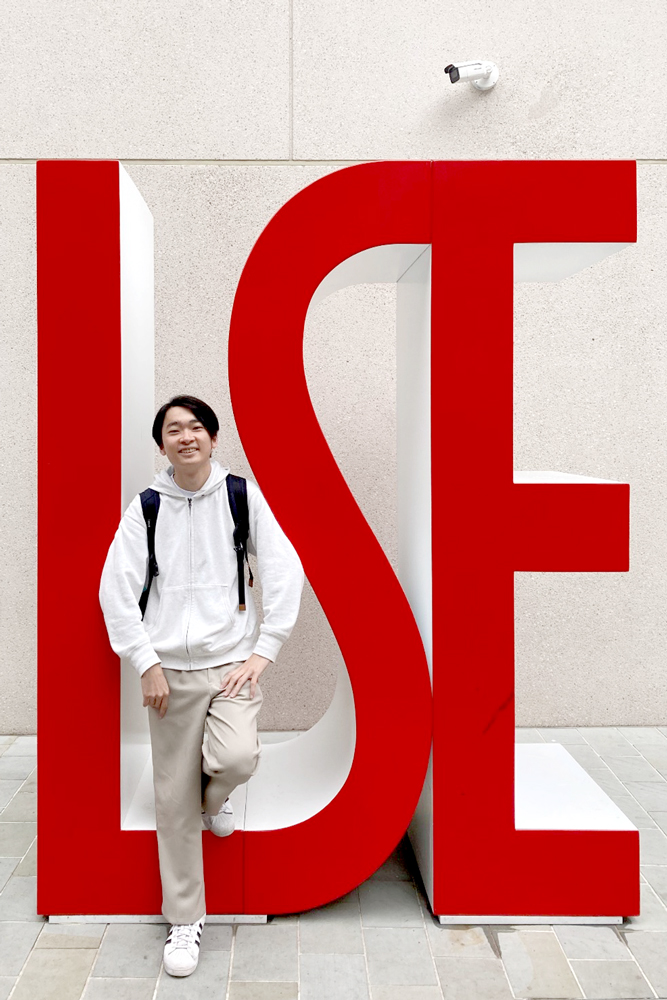
Before studying abroad, I didn't have a clear vision of my career path. So, to explore the answer, I participated in the summer school at LSE (London School of Economics), a world-class learning environment. LSE provided tuition fees for one subject and dormitory fees, so I was able to concentrate on my studies without financial worries.
The important thing for me in choosing the course was to use data and handle real data using software. In the economics theory I had studied, I felt that the deductive approach had very strong assumptions. Therefore, I was interested in an inductive approach using real data, and I was also attracted by the practical applications in social science. Since LSE is a university with a strong focus on social science, I chose it because I wanted to take classes taught by professors there.
The courses I took at the LSE summer school were ME314: Introduction to Data Science and Machine Learning and ME202: Social Network Analysis. Both courses used the programming language "R" created for statistical analysis to analyze data. ME314 analyzed and predicted quantitative and qualitative data such as those used in economic analysis. It was the most difficult course, with more than half of the content being at the graduate school level. Unlike ME314, ME202's data itself is familiar in matrix format, but the analytical methods and interpretation were very difficult. Specifically, the subjects were diverse, including analysis of human relationship structures within companies, product diffusion structures, and predictions from a network perspective in human decision-making. The difficulty level was classified as medium, and although formula proofs and detailed parts were not required, the content itself is dealt with in graduate school, so it took time to understand deeply, and I felt that the application and interpretation of networks were very difficult. Both courses use data to apply and analyze theories, so I recommend them to people who have a certain degree of interest and want to actually try them out.
The important thing for me in choosing the course was to use data and handle real data using software. In the economics theory I had studied, I felt that the deductive approach had very strong assumptions. Therefore, I was interested in an inductive approach using real data, and I was also attracted by the practical applications in social science. Since LSE is a university with a strong focus on social science, I chose it because I wanted to take classes taught by professors there.
The courses I took at the LSE summer school were ME314: Introduction to Data Science and Machine Learning and ME202: Social Network Analysis. Both courses used the programming language "R" created for statistical analysis to analyze data. ME314 analyzed and predicted quantitative and qualitative data such as those used in economic analysis. It was the most difficult course, with more than half of the content being at the graduate school level. Unlike ME314, ME202's data itself is familiar in matrix format, but the analytical methods and interpretation were very difficult. Specifically, the subjects were diverse, including analysis of human relationship structures within companies, product diffusion structures, and predictions from a network perspective in human decision-making. The difficulty level was classified as medium, and although formula proofs and detailed parts were not required, the content itself is dealt with in graduate school, so it took time to understand deeply, and I felt that the application and interpretation of networks were very difficult. Both courses use data to apply and analyze theories, so I recommend them to people who have a certain degree of interest and want to actually try them out.
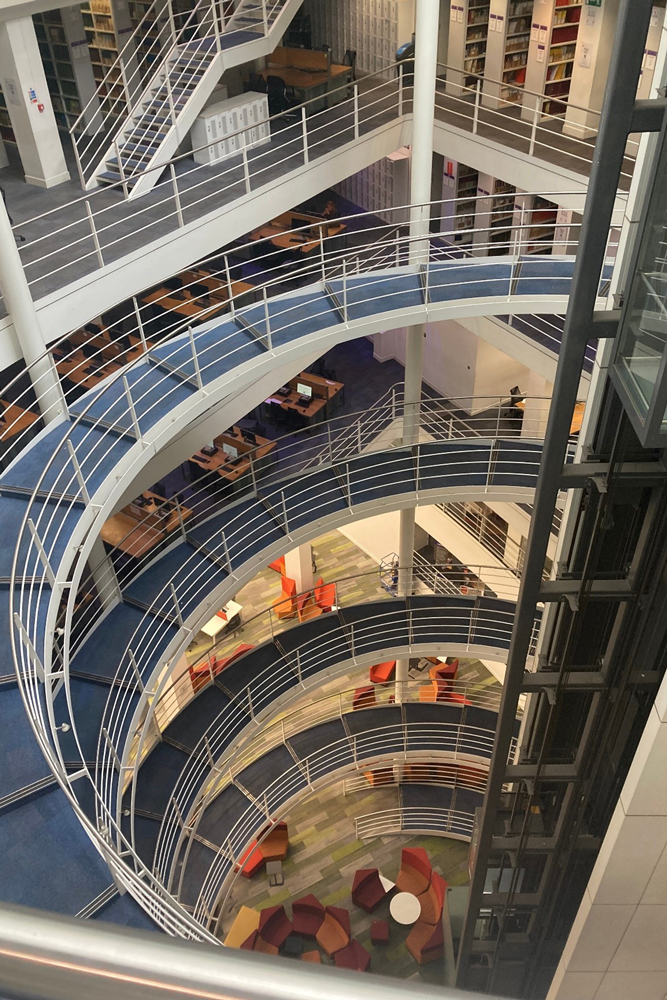
In class, I learned how to use other resources when I understood about 80% of the material, rather than pursuing perfection. To be honest, I studied hard at summer school, aiming to be the top. However, the top students were overwhelmingly smarter than I had ever met, and I was overwhelmed. I realized that even if I tried hard, I would never be able to beat them. So I realized that there are more important things than sticking to it. I realized that I don't have the ability to do it myself, and it's better to understand everything more than 80%, combine knowledge well, and tackle the assignment. The biggest thing I gained from classes and classmates at LSE was finding a good way to make the most of my efforts and use time, the greatest resource in life, efficiently.
Also, my biggest growth is my attitude of connecting effort to results. The summer school was quite short, and I crammed in three weeks what I would have learned in a year. ME314 in particular was difficult, and I expected to fail if I didn't prepare in advance. Also, classes started on July 10th, and the University of London exam was until the end of May, so I had about one month to prepare. So, I understood the theory of the corresponding 400 pages of the textbook in two weeks, and for the rest of the time, I started studying R because I had never touched it before. Even at that point, it was quite hard, but the actual summer school was even harder. Fortunately, my preparation paid off, and I was able to handle the theory to a certain extent, but I had a lot of trouble with the application and R exercises. However, I thought that it would be difficult to connect it to results with just my own knowledge and ideas, so I actively asked my classmates and teachers questions to deepen my understanding and greedily absorbed new interpretations and approaches. As a result, I was able to get the highest grade in my grades. Also, by making use of this attitude, I was able to get the highest grade in the ME202 course.
Also, my biggest growth is my attitude of connecting effort to results. The summer school was quite short, and I crammed in three weeks what I would have learned in a year. ME314 in particular was difficult, and I expected to fail if I didn't prepare in advance. Also, classes started on July 10th, and the University of London exam was until the end of May, so I had about one month to prepare. So, I understood the theory of the corresponding 400 pages of the textbook in two weeks, and for the rest of the time, I started studying R because I had never touched it before. Even at that point, it was quite hard, but the actual summer school was even harder. Fortunately, my preparation paid off, and I was able to handle the theory to a certain extent, but I had a lot of trouble with the application and R exercises. However, I thought that it would be difficult to connect it to results with just my own knowledge and ideas, so I actively asked my classmates and teachers questions to deepen my understanding and greedily absorbed new interpretations and approaches. As a result, I was able to get the highest grade in my grades. Also, by making use of this attitude, I was able to get the highest grade in the ME202 course.
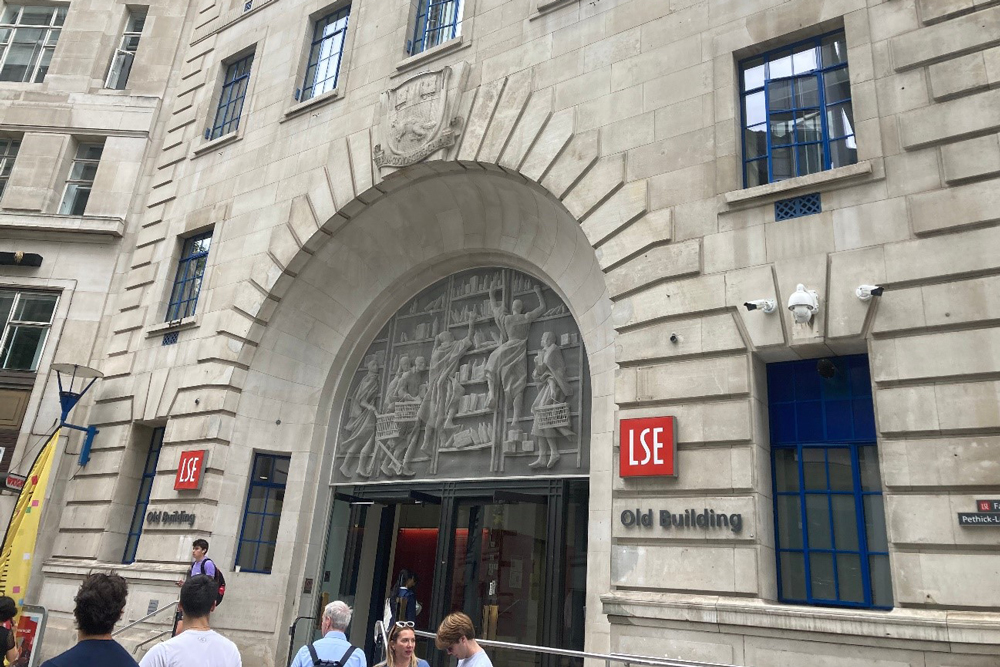
The thing I struggled with in class was the language barrier. Basically, the class proceeds under the assumption that the students have native or equivalent English ability, so there were almost no times when I was able to understand the class 100%. I made up for this by doing my homework beforehand, reviewing after class, and studying with friends.
Through my interactions with others, I realized that the impact of the environment is huge, not only contributing to a person's growth and abilities, but also deeply related to information gaps, network building, and important decision-making. For example, I joined a study network of Yale University undergraduates and graduate students from UCB (University of California, Berkeley) and LSE, and shared information with them, further improving the quality of my studies. Through these experiences, I was motivated to work hard every day to move to a higher environment.
Based on the above, I will use this experience as a foundation for my future life. Specifically, I have two ideas. The first is that I would like to conduct analysis that combines economics and data science in graduate school. This is assuming that I go on to graduate school. On the other hand, the second is that I would like to join a company that handles actual data and analyzes and predicts market trends.
Although I haven't yet found an answer to my first question about my career path, I plan to think more deeply about the areas that interest me and make a decision after listening to what various people have to say.
Through my interactions with others, I realized that the impact of the environment is huge, not only contributing to a person's growth and abilities, but also deeply related to information gaps, network building, and important decision-making. For example, I joined a study network of Yale University undergraduates and graduate students from UCB (University of California, Berkeley) and LSE, and shared information with them, further improving the quality of my studies. Through these experiences, I was motivated to work hard every day to move to a higher environment.
Based on the above, I will use this experience as a foundation for my future life. Specifically, I have two ideas. The first is that I would like to conduct analysis that combines economics and data science in graduate school. This is assuming that I go on to graduate school. On the other hand, the second is that I would like to join a company that handles actual data and analyzes and predicts market trends.
Although I haven't yet found an answer to my first question about my career path, I plan to think more deeply about the areas that interest me and make a decision after listening to what various people have to say.