
 3S
3S


Global Program / Digital Humanities Program
Global Programs
Two global programs to hone your "language skills" and "eyes on the world"

Since ancient times, humans have been called "the animal endowed with language."
If this is so, then mastering a language should signify an increase in one's human potential, and one should become aware of one truth: every culture is open to all people.
Understanding a language or culture meansworld " to challenge None other than, All People It is important to have the ability to see the view that unfolds before you.
Global Challenges and Global Humanities are two new programs that aim to open such doors, connecting not only people living now, but also people of the past and future.
If this is so, then mastering a language should signify an increase in one's human potential, and one should become aware of one truth: every culture is open to all people.
Understanding a language or culture means
Global Challenges and Global Humanities are two new programs that aim to open such doors, connecting not only people living now, but also people of the past and future.
Global Challenge (GC)
The purpose of this program is to improve students' overall command of each foreign language while building on the knowledge of foreign cultures they will learn in each department. The goal is to reach a level where students can hold discussions and attend lectures in the foreign language.
English Module
Department of British and American Studies is a program that students can choose from. Choose a recommended course from General Education Courses, Interdepartmental Specialized Courses, major Specialized Courses, etc. The purpose of this program is to acquire advanced English and practical skills by taking classes in English, as well as experiencing various programs (field training, internships, and volunteering) conducted in Study Abroad through University Agreement, certified study abroad, and overseas.
English Program
This program is available to students of Department of European Studies and Department of Department of Japanese and East-Asian Studies. Students select and take designated courses from Elective Foreign Language II, General Education Courses, and Interdepartmental Specialized Courses. Interdepartmental Specialized Courses "GC English" is compulsory. In addition, students must write their graduation thesis in English, or write a graduation thesis in Japanese that uses English literature as the subject of research or as reference material, and attach an English abstract.
German Program/German Associate Program
In Department of European Studies it is a program, while in Department of British and American Studies and Department of Japanese and East-Asian Studies, it is an associate program. In all cases, "GC German" is a required subject, and Related Courses include "Society and Culture of German-speaking Countries" and "German Essay Practice", and semi-Related Courses include "Intermediate German Composition", "Intermediate German Conversation", and "Advanced German Reading". The aim is to acquire a high level of German language proficiency to study abroad. In Department of European Studies, students are also required to write a graduation thesis in German, or write a graduation thesis in Japanese that uses German literature as the subject of research or reference and include a German abstract.
French Program / French Associate Program
In Department of European Studies it is a program, while in Department of British and American Studies and Department of Japanese and East-Asian Studies it is an associate program. In all cases, "GC French" is a required subject, and Related Courses include "French History and Society" and "French Essay Practice", and semi-Related Courses include "Intermediate French Composition", "Intermediate French Conversation", and "Advanced French Reading". The aim is to acquire a high level of French language proficiency to study abroad. In Department of European Studies, students are also required to write a graduation thesis in French, or write a graduation thesis in Japanese that uses French literature as the research subject or reference book and attach a French abstract.
Chinese Language Program/Chinese Language Associate Program
In Department of Japanese and East-Asian Studies it is a program, while in Department of British and American Studies and Department of European Studies it is an associate program. In all cases, "GC Chinese" is a required subject, and Related Courses include "Chinese Society and Culture" and "Chinese Essay Writing Practice." The aim is to acquire a high level of Chinese language proficiency to study abroad. In Department of Japanese and East-Asian Studies, students are also required to write a graduation thesis in Chinese, or write a graduation thesis in Japanese that uses Chinese literature as the research subject or reference book and includes a Chinese abstract.
Korean Language Program / Korean Language Associate Program
In Department of Japanese and East-Asian Studies it is a program, while in Department of British and American Studies and Department of European Studies it is an associate program. In all cases, "GC Korean" is a required subject, and Related Courses include "Korean Society and Culture" and "Korean Essay Writing Seminar." The aim is to acquire advanced Korean language skills to a level that will enable one to study abroad. In Department of Japanese and East-Asian Studies, students are also required to write their graduation thesis in Korean, or write a graduation thesis in Japanese that uses Korean literature as the research subject or reference book and includes an abstract in Korean.
Global Humanities (GH)
Three-department common program
Compare the courses offered by each department and experience the newness of the GH lineup. Seminars and workshops are held in small groups, allowing students with global interests to interact across the boundaries of the three departments of Faculty of Humanities.
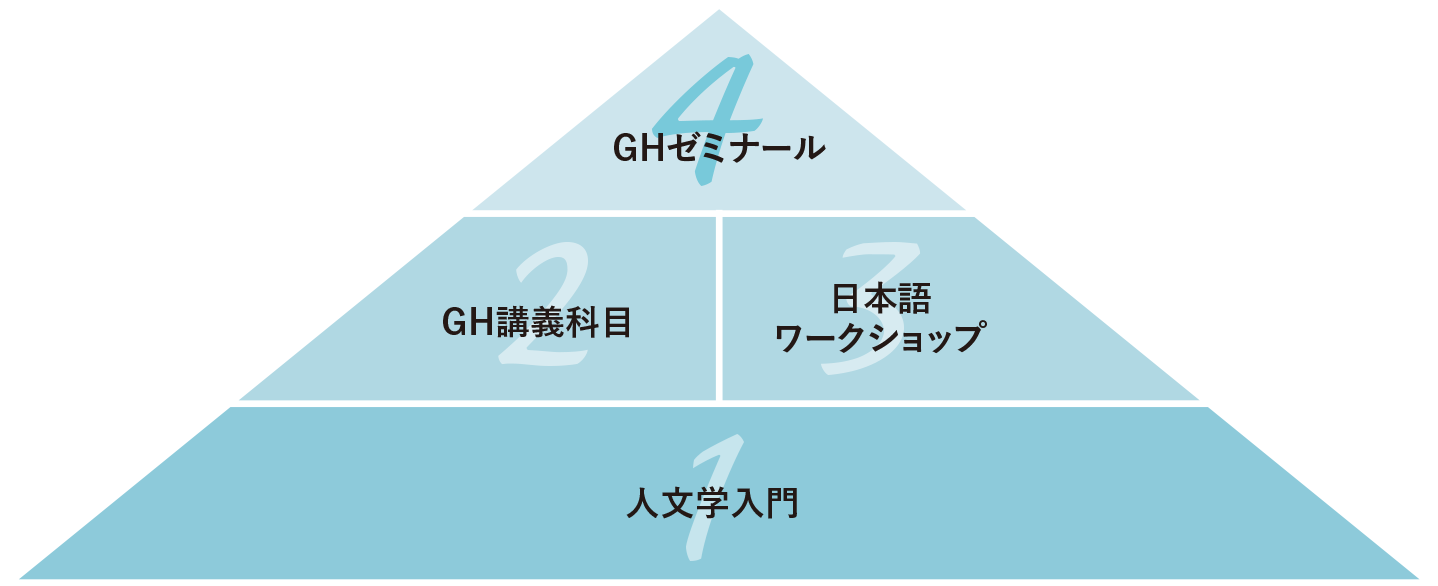
Course Groups and Course Entrance Schedule
"Introduction to Humanities" is a required course. After that, students will be required to select and take courses from "GH Lecture Courses," "Japanese Language Workshop," and "GH Seminar." In addition, students will be required to write their graduation thesis in a foreign language (English, German, French, Chinese, or Korean), or write a graduation thesis in Japanese using foreign language literature as the research subject or reference book and attach an abstract in the foreign language (the foreign language used will be one that can be taught within each department).
Introduction to humanities
Focusing on the three fields of literature, art, and history, you will learn what "humanities" are. The goal is to understand the appeal and importance of the humanities through literature and texts (including performing arts and visual arts) that underlie each field. Think about what field is best for you and how the humanities relate to modern society.
GH lecture subjects
This is a new group of lecture courses that aims to introduce basic knowledge of the humanities while following the constantly updated state of knowledge. It consists of eight courses: "Japanese Literature in the World," "Japanese Representation and Culture," "Digital Humanities," "Languages and Societies of the World," "Introduction to Gender Studies," "Body and Art," "History, Memory, and Archives," and "Introduction to Humanity Criticism." The point is to complement the regional learning in each department.
Japanese Language Workshop
This workshop aims to help students to reexamine Japanese from various angles and acquire more sophisticated Japanese language skills. Through practical activities such as debate, criticism, and creation, students will learn how to use Japanese logically and creatively. The goal is to acquire vocabulary, expression, text comprehension, and logical construction skills that will be useful not only for graduation thesis but also for the general public and graduate school. The focus is on supporting the acquisition of foreign languages and improving language ability in a comprehensive manner.
GH Seminar
This is a joint seminar course of three departments. In addition to regular presentations and discussions, students will deepen their humanistic education in a more practical way through material analysis, field work, sports, art criticism, and text reading. Students will develop an eye for critically grasping social trends that tend to be visualized from a broader perspective that is different from the specialized perspectives acquired in each department.
Digital Humanity Program (Starting in fiscal year 2027)
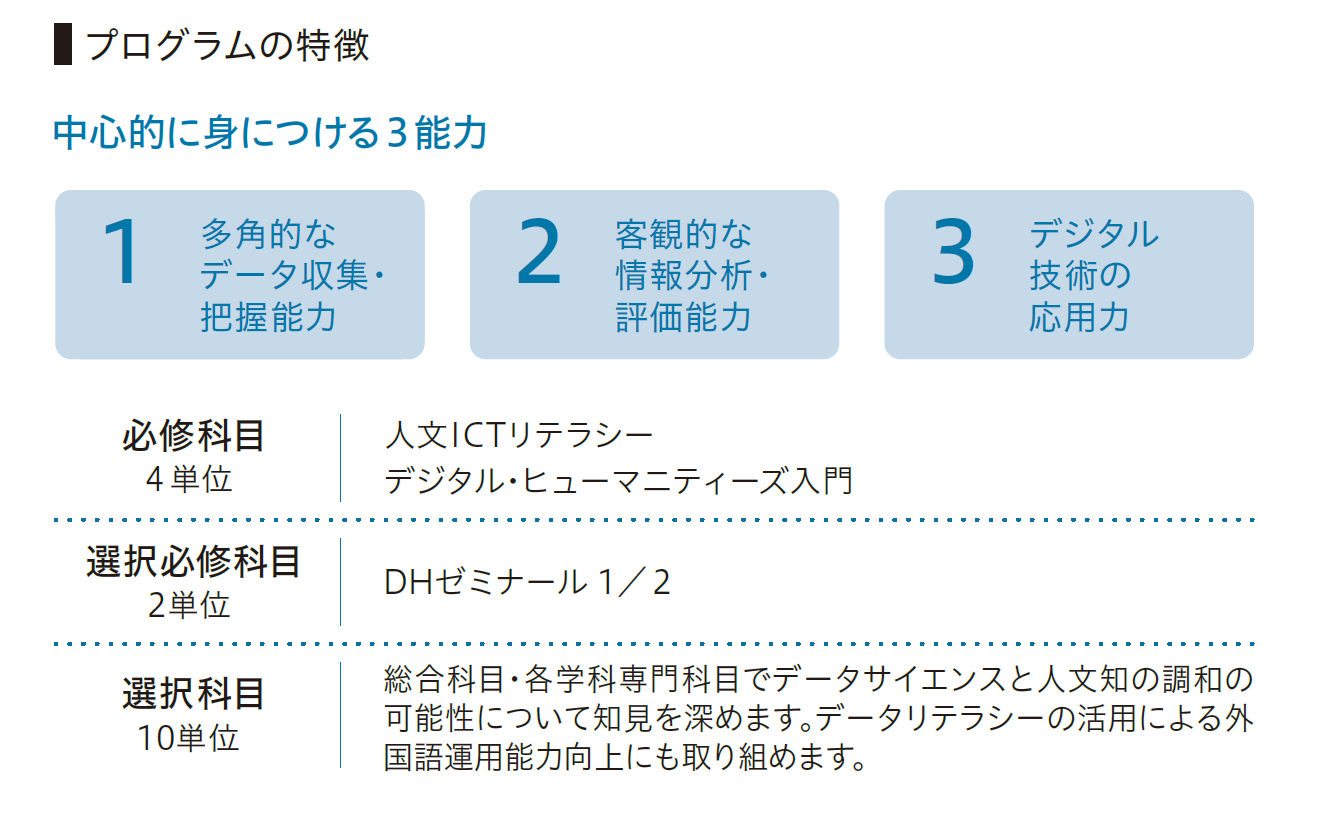
The Digital Humanities (DH) Program is an academic learning program that helps students acquire the ability to apply data science knowledge in the humanities.
By engaging in humanities knowledge using various digital technologies, students acquire "multifaceted data collection and grasp capabilities," "objective information analysis and evaluation skills," and "the ability to apply digital technologies," enabling flexible adaptation to future technological changes.
By engaging in humanities knowledge using various digital technologies, students acquire "multifaceted data collection and grasp capabilities," "objective information analysis and evaluation skills," and "the ability to apply digital technologies," enabling flexible adaptation to future technological changes.