
 3S
3S


Course Model and Class Introduction
- Course Diagram
- Course model
- Bachelor's Degree in Data Science and Business Analytics Course Model
- Bachelor of Economics Coursework Model
- Course details
PDP Curriculum Map
Classes at the University of London are a build-up method that ensures that knowledge is acquired through systematic learning. If you pass the final exam of the IFP (Basic Education Programme) in your first year, you can take the BSc (Professional Education Programme) from your second year. Passing an annual exam for the next three years will earn you a bachelor's degree from the University of London (BSc Economics and Management or BSc Data Science and Business Analytics or BSc Economics).
- BSc Economics and Management Course Schedule
- BSc Data Science and Business Analytics Course Model
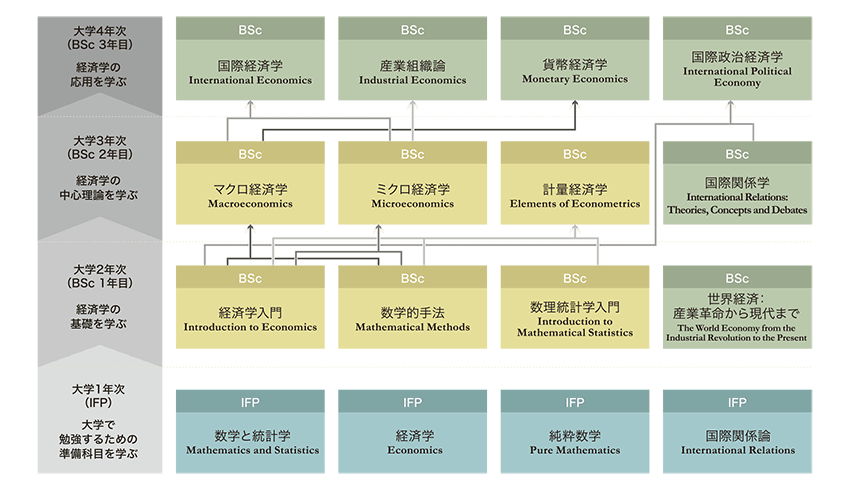
- BSc Economics Course Schedule
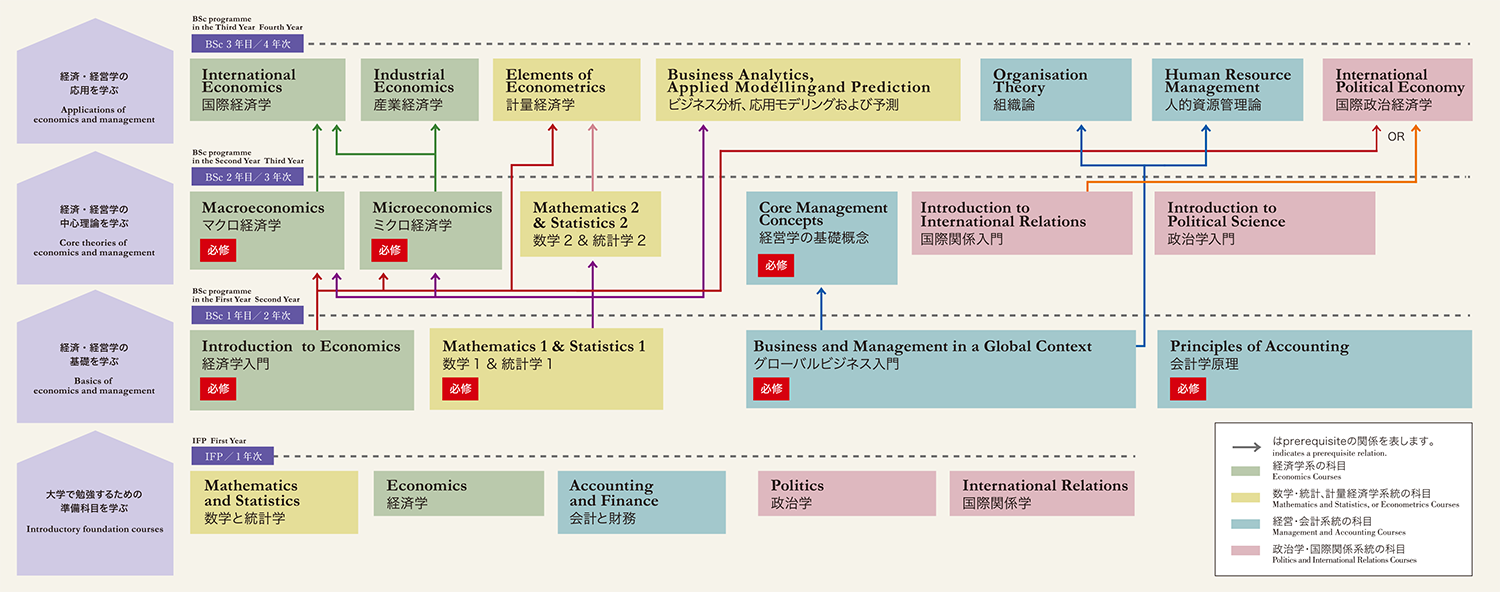
BSc Economics and Management Course Model
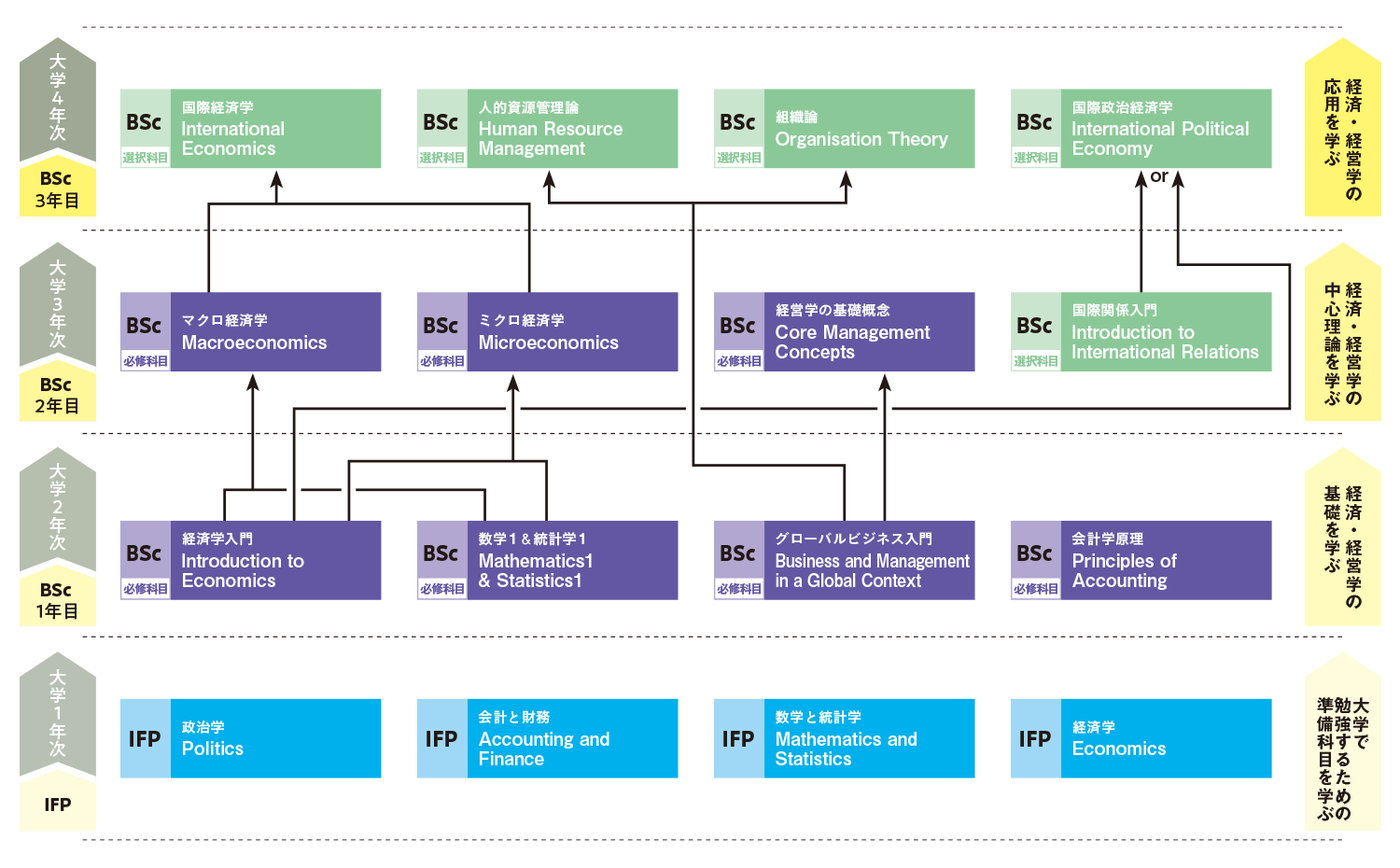
BSc Data Science and Business Analytics Course Model

BSc Economics (Bachelor of Economics) Course Pattern
Course details
IFP/Musashi University 1st year: Study preparatory subjects for university studies

| IFP Economics |
You will learn key economic concepts, consider how economics can be applied to everyday problems, and learn how economics is an important tool for understanding a wide range of issues.
|
|---|---|
| IFP Accounting and Finance |
This is an introductory course leading to the study of Principles of Accounting, where students will learn the basics of accounting in general and finance.
|
| IFP Mathematics and Statistics |
Learn key numerical and statistical concepts and methods for use in economics, business administration, finance, and related fields, laying the foundation for future study.
|
| IFP International Relations |
This course introduces students to the basic concepts, theories, and empirical information necessary to understand a variety of contemporary phenomena observed around the world. It examines central questions in international relations, such as: Why do wars happen? Can international organizations solve global problems? and what answers they can provide. This course helps students analyze contemporary international relations issues from multiple perspectives and understand the real world based on the theoretical and empirical knowledge learned in class.
|
| IFP Politics |
This introductory course in political science will provide an overview of the political situation in each country, political systems such as presidential and parliamentary systems, and the roles of important actors who can influence policy.
|
| IFP 純粋数学 Pure Mathematics |
It covers more advanced topics in mathematics, such as trigonometric functions, algebraic geometry, differential calculus, vectors, and more.
|
BSc 1st year / Musashi University 2nd year: Learn the basics of economics and business administration

| BSc Introduction to Economics |
This course introduces the basic concepts and models of microeconomics and macroeconomics, such as consumer and producer choice, welfare economics, aggregate demand and supply, unemployment, growth theory, and open economy.
|
|---|---|
| BSc Business and Management in a Global Context |
This course will teach you about the responses required of management as companies globalize. The aim is to deepen your understanding of the actions required of companies in an increasingly globalized environment.
|
| BSc Mathematics 1 & Statistics 1 Mathematics 1 & Statistics 1 |
In mathematics, we will focus on optimization while also introducing the basics of differentiation and integration, linear algebra, and sequences. In statistics, we will introduce basic concepts such as probability theory, estimation, and testing, as well as basic linear regression analysis and correlation analysis.
|
| BSc Principles of Accounting |
You will learn the basics of financial accounting and management accounting. Lessons are given in a way that is useful not only for theory but also for practical application.
|
| BSc 数学メソッド Mathematical Methods |
Students will develop the ability to use mathematical methods and deal with applications in economics and business administration.
|
| BSc 数学的統計学入門 Introduction to Mathematical Statistics |
This course covers introductory content on probability theory, distribution theory, and statistical reasoning.
|
BSc 2nd year/Musashi University 3rd year: Study the core theories of economics and business administration
| BSc Macroeconomics |
We will examine representative macroeconomic models related to business cycles, unemployment, inflation, growth theory, open macroeconomics, and the implications of monetary and fiscal policies.
|
|---|---|
| BSc Microeconomics |
This course develops the ability to approach and analyze real-world economic problems from a microeconomic perspective, with a focus on consumer behavior, corporate behavior, market functions, and the role of government.
|
| BSc Core Management Concepts |
This course introduces basic theories and concepts in business administration and related fields. Specifically, students will study fields such as management strategy theory, marketing, organizational theory, and accounting.
|
| BSc Introduction to International Relations |
The aim is to enable students to analyse not only historical events but also current international events from the theoretical standpoint of international relations.
|
| BSc Introduction to Political Science |
Students will learn basic theories and research methods in political science and use these to explore the principles of political actor behavior, the workings of political institutions, and policy consequences.
|
| BSc 上級統計学 Advanced Statistics |
This course covers advanced topics in statistical inference, such as distribution theory, maximum likelihood estimation, confidence intervals, hypothesis testing, and Bayesian statistics.
|
| BSc 経営科学の方法 Management Science Methods |
It teaches mathematical methods, modeling techniques, and statistical methods to solve real-world problems.
|
| BSc データサイエンスのためのプログラミング Programming for Data Science |
It covers the basic principles of computer programming with a focus on data science applications.
|
| BSc 世界経済:産業革命から現代まで The World Economy: Industrial Revolution to the Present |
An overview of the history of the development and integration of the world economy from the Industrial Revolution to the present day.
|
BSc 3rd year/Musashi University 4th year: Studying applied economics and business administration

| BSc International Economics |
You will study international trade and finance, gaining an understanding of trade patterns and benefits, trade policy, exchange rate determination, the effects of macroeconomic policies, and financial crises.
|
|---|---|
| BSc Industrial Economics |
From an economics perspective, students will learn about corporate characteristics, forms of inter-company competition, pricing, quality differentiation, market structure, and industrial policy, and develop the ability to analyze a variety of issues surrounding industry.
|
| BSc Econometrics Elements of Econometrics |
This course covers the fundamentals of econometrics, with an emphasis on cross-sectional regression analysis, but also covers basic ideas on how to process time series data. Specifically, you will learn about the method of least squares (OLS), logistic/probit regression, maximum likelihood estimation (MLE), and many important issues related to the use of time series data. The material covered in this course will provide the foundation necessary to learn more advanced techniques such as panel data regression analysis and difference in differences (DID).
|
| BSc Business Analytics, Applied Modelling and Prediction |
Learn how to apply statistics to real business. Using Bayes' theorem and the Decision Tree, students will learn how to guide optimal strategies in an uncertain world. You'll also submit assignments using Tableau, a business intelligence software.
|
| BSc Organization Theory |
After learning how economics, psychology, sociology and other fields think about organizations, you will learn how to design organizations that meet specific purposes.
|
| BSc Human Resource Management Theory |
This course covers approaches that companies and organizations use to recruit, retain and motivate employees, including recruitment and selection methods, systems and practices, employee management methods, and turnover and firing policies.
|
| BSc International Political Economy |
Students will study relationships between countries, as well as between countries and corporations and international organizations, from the perspective of international relations, and deepen their understanding of global issues.
|
| BSc Monetary Economics |
This course provides an overview of the complex role that money, its creation, and its management play in the modern economy. It explores the mechanisms behind the money supply and its impact on inflation, interest rates, and economic growth, as well as the relationship between monetary and fiscal policy and the stabilization of exchange and financial markets.
|
| BSc 機械学習 Machine Learning |
It covers a wide range of machine learning models and algorithms, explaining them through a variety of real-world applications and datasets, as well as introducing the theoretical foundations.
|
| BSc 市場調査のための統計手法 Statistical Methods for Market Research |
Students will focus on various aspects of market research and apply various multivariate statistical methods in practice.
|