
 3S
3S


LSE Summer School Experience 2022
Faculty of Economics Department of Economics PDP 6th Year Student (Enrolling in April 2020)
Tokyo Metropolitan Musashino-Kita High School From
■Host University:London School of Economics and political science
■Study period (local stay period): July to August 2022
Tokyo Metropolitan Musashino-Kita High School From
■Host University:London School of Economics and political science
■Study period (local stay period): July to August 2022
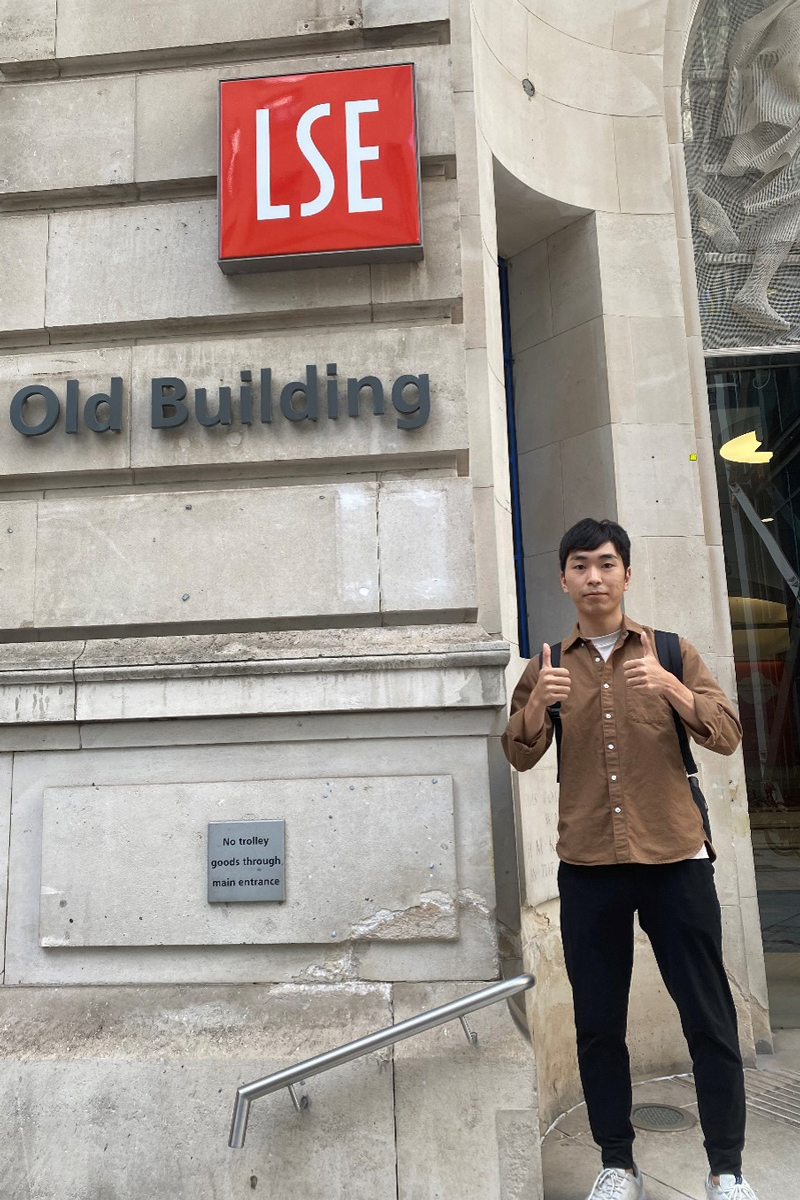
I am part of the PDP (Parallel Degree Program) and am taking the University of London curriculum at Musashi University. I have always wanted to study abroad and live alone for a while. In addition, the LSE Summer School allows me to take classes on the campus of the LSE (London School of Economics) in London, England, the leader of the PDP course, so I decided not to miss this opportunity and took on the challenge, even though it was only a short period of about three weeks.
During the summer school, I took Marketing, a course in the 100s. The course was divided into a 1.5 hour class in the morning and a 3 hour lecture in the afternoon.
First, in the lecture, all students participating in the course received a lecture from the professor in a large lecture hall. The professor often asked the students for their opinions, and if there was something they did not understand, they could immediately ask, making it a two-way, question-and-answer style lecture. The lecture content included learning about marketing frameworks and analysis methods, using actual companies and products as examples.
The classes were divided into groups of about 15 students. Each day, students were given a document (about 10 to 20 pages) about a real company or event, and they had to study it in advance. They then used the knowledge they had gained in the lectures to solve problems. The classes were basically centered around discussions, and students exchanged opinions with their classmates to deepen their understanding.
The assessment method was divided into 40% coursework and 60% final exam. The coursework was done in pairs with classmates, choosing one case that was covered in class and solving the problem based on the lecture. Since two people created one assignment, my understanding was deeper. The other exam was an open-book, take-home exam. Since marketing is actually used with various information, memorization was not necessary, and the exam was formatted to answer the problem as best as possible using the knowledge I had (frameworks, etc.). It was a basic essay type exam like the PDP Politics and Business and Management in a Global Context exams, but figures and bullet points were allowed, and I was required to communicate clearly.
Even though it was a 100-level course, all the other students around me had language skills comparable to native speakers, so it was a very high-level environment. Many of the students were attending other English-speaking universities and were taking this course only during the summer holidays. It was very difficult for me, and I was barely able to keep up by doing very thorough preparation and review every day in the library and in the dormitory. In particular, the class discussions were quite tough for me personally, because you can't express your opinion unless you are well prepared. However, I think that the discussions allowed me to acquire more practical and usable knowledge because various opinions were exchanged. In addition, the library was very large, had a large collection of books and PCs, and was perfectly equipped for self-study, so I studied hard until late at night, just like many other students.
I rented a single room in Sidney Webb House, owned by LSE. The room had a toilet and shower, and I could use the shared kitchen and coin laundry, so I had almost no problems. Since I could have breakfast on campus, I would take the bus for about 20 to 30 minutes in the morning to school, attend classes, study, and then walk home for about 40 minutes, taking various routes. Since everything in London is within walking distance, I could just walk around and enjoy the cityscape, or visit museums and tourist spots, and it was a very enjoyable day. I saw local news that "Europe is also experiencing serious heatwaves due to abnormal weather," but the humidity was overwhelmingly lower than in Japan, and it was very comfortable. In the early mornings, it was a bit chilly, so a hoodie would be very useful. As for the coronavirus, it seemed like pre-coronavirus life had returned, with tourists occasionally wearing masks, so I forgot about the coronavirus. Also, unlike Japan, everything was paid for by card, so I felt the cultural differences even in small everyday things like that. However, London is already an expensive city, and the weak yen also had an impact, making prices very high and increasing living expenses, including food costs.
There were many events organized by the summer school on weekends and after class on weekdays, and in particular, the sunset cruise on the Thames River was a very valuable experience, not only because of the beautiful scenery, but also because I was able to meet and get along well with other international students there. Aside from the summer school, as I personally love soccer, I went to watch a Premier League match. The heat, cheers, and unity were overwhelming, incomparable to Japan. As I arrived at the stadium quite early, I was able to deepen my interactions with the local supporters nearby, which was a wonderful experience.
By interacting with people from various countries, including not only the UK, but also China, Taiwan, Singapore, India, the US, France, Italy, and Spain, I was able to experience the differences in culture and ways of thinking. Also, experiencing these differences gave me the opportunity to think more deeply about the good and bad points of Japan. The motivation and approach to learning of the students around me were all really wonderful, and I realized that I have to improve myself in the future. To be honest, there were times when I felt the "language barrier," so I felt that the world could be expanded so much by being able to use English well. Although it was a short-term study abroad program of about three weeks, it was very intense and hard, and I think it was a valuable experience that will give me a very important opportunity for the future.
During the summer school, I took Marketing, a course in the 100s. The course was divided into a 1.5 hour class in the morning and a 3 hour lecture in the afternoon.
First, in the lecture, all students participating in the course received a lecture from the professor in a large lecture hall. The professor often asked the students for their opinions, and if there was something they did not understand, they could immediately ask, making it a two-way, question-and-answer style lecture. The lecture content included learning about marketing frameworks and analysis methods, using actual companies and products as examples.
The classes were divided into groups of about 15 students. Each day, students were given a document (about 10 to 20 pages) about a real company or event, and they had to study it in advance. They then used the knowledge they had gained in the lectures to solve problems. The classes were basically centered around discussions, and students exchanged opinions with their classmates to deepen their understanding.
The assessment method was divided into 40% coursework and 60% final exam. The coursework was done in pairs with classmates, choosing one case that was covered in class and solving the problem based on the lecture. Since two people created one assignment, my understanding was deeper. The other exam was an open-book, take-home exam. Since marketing is actually used with various information, memorization was not necessary, and the exam was formatted to answer the problem as best as possible using the knowledge I had (frameworks, etc.). It was a basic essay type exam like the PDP Politics and Business and Management in a Global Context exams, but figures and bullet points were allowed, and I was required to communicate clearly.
Even though it was a 100-level course, all the other students around me had language skills comparable to native speakers, so it was a very high-level environment. Many of the students were attending other English-speaking universities and were taking this course only during the summer holidays. It was very difficult for me, and I was barely able to keep up by doing very thorough preparation and review every day in the library and in the dormitory. In particular, the class discussions were quite tough for me personally, because you can't express your opinion unless you are well prepared. However, I think that the discussions allowed me to acquire more practical and usable knowledge because various opinions were exchanged. In addition, the library was very large, had a large collection of books and PCs, and was perfectly equipped for self-study, so I studied hard until late at night, just like many other students.
I rented a single room in Sidney Webb House, owned by LSE. The room had a toilet and shower, and I could use the shared kitchen and coin laundry, so I had almost no problems. Since I could have breakfast on campus, I would take the bus for about 20 to 30 minutes in the morning to school, attend classes, study, and then walk home for about 40 minutes, taking various routes. Since everything in London is within walking distance, I could just walk around and enjoy the cityscape, or visit museums and tourist spots, and it was a very enjoyable day. I saw local news that "Europe is also experiencing serious heatwaves due to abnormal weather," but the humidity was overwhelmingly lower than in Japan, and it was very comfortable. In the early mornings, it was a bit chilly, so a hoodie would be very useful. As for the coronavirus, it seemed like pre-coronavirus life had returned, with tourists occasionally wearing masks, so I forgot about the coronavirus. Also, unlike Japan, everything was paid for by card, so I felt the cultural differences even in small everyday things like that. However, London is already an expensive city, and the weak yen also had an impact, making prices very high and increasing living expenses, including food costs.
There were many events organized by the summer school on weekends and after class on weekdays, and in particular, the sunset cruise on the Thames River was a very valuable experience, not only because of the beautiful scenery, but also because I was able to meet and get along well with other international students there. Aside from the summer school, as I personally love soccer, I went to watch a Premier League match. The heat, cheers, and unity were overwhelming, incomparable to Japan. As I arrived at the stadium quite early, I was able to deepen my interactions with the local supporters nearby, which was a wonderful experience.
By interacting with people from various countries, including not only the UK, but also China, Taiwan, Singapore, India, the US, France, Italy, and Spain, I was able to experience the differences in culture and ways of thinking. Also, experiencing these differences gave me the opportunity to think more deeply about the good and bad points of Japan. The motivation and approach to learning of the students around me were all really wonderful, and I realized that I have to improve myself in the future. To be honest, there were times when I felt the "language barrier," so I felt that the world could be expanded so much by being able to use English well. Although it was a short-term study abroad program of about three weeks, it was very intense and hard, and I think it was a valuable experience that will give me a very important opportunity for the future.