
 3S
3S


Founding principles and basic educational goals
- Founding Philosophy
- Basic Educational Goals
- Liberal Arts and Sciences Education
- Founder Nezu Kaichiro
Founding Philosophy
The Three Founding Principles
- To produce individuals dedicated to our nation’s ideal of incorporating the cultural values of East and West
- To produce individuals equal to the challenge of acting on the world stage
- To produce individuals capable of independent thought and research
Roots in Japan's first private seven-year High School
Musashi University was active in the financial world from the end of the Meiji period to the early Showa period. Nezu Kaichiro (first generation) However, its roots lie in the former Musashi High School High School, which was founded in 1922 (Taisho 11) with the aim of contributing to society.
Musashi High School, under the former system, upheld the ideal of "nurturing outstanding human resources who will lead the new Japan of tomorrow, with character development at its core," and following subsequent educational reforms, became Musashi University in 1949. In today's rapidly changing social environment, the "The Three Founding Principles" set forth at the time of the founding of the former high school remain the starting point for our university's education.
Musashi High School, under the former system, upheld the ideal of "nurturing outstanding human resources who will lead the new Japan of tomorrow, with character development at its core," and following subsequent educational reforms, became Musashi University in 1949. In today's rapidly changing social environment, the "The Three Founding Principles" set forth at the time of the founding of the former high school remain the starting point for our university's education.
Musashi University 's Basic Educational Goals
Based on the founding principles (The Three Founding Principles), Musashi University trains human resources through university-wide Comprehensive Knowledge courses (i.e. General Education Courses, Foreign Language Courses, and University-Wide Specialized Courses) and Specialized Courses of each Specialized Knowledge at the undergraduate level, and through the unique educational curriculum of each graduate school at the graduate level, in accordance with the philosophy of "liberal arts and sciences." The liberal arts at Musashi University refer to comprehensive and interdisciplinary education that goes beyond the traditional division between general education and specialized fields. Science refers to mathematical sciences such as mathematics and statistics, natural sciences such as physics, chemistry, and biology, and social sciences such as economics, sociology, and political science. Humanities-related studies are called humanities or humanities. Because liberal arts and science overlap, Musashi University uses the term "liberal arts and sciences." This also expresses the spirit of Integration of Humanities and Sciences. Musashi University aims to Integration of Humanities and Sciences and sciences by utilizing information and data provided by science-related studies in the humanities education and research fields. The ability to collaborate with others and practical skills are cultivated in small-group educational settings such as seminars and practical training, which is a tradition at Musashi University. As the world becomes more integrated, the ultimate goal of liberal arts and science education is to cultivate global leaders who can contribute to promoting people-to-people exchanges across the world and resolving organizational, regional, and global issues, and work on intellectual exploration and practical activities in their own immediate surroundings, equipped with well-balanced comprehensive and specialized knowledge, the ability to work together with others, and practical skills acquired through liberal arts and sciences education.
Musashi University 's "Liberal Arts and Science Education"
(Musashi University This is an explanation for students about "Liberal Arts & Science Education". )
The Musashi University curriculum is based on the "liberal arts" and "science" studies described at the beginning of the university's Diploma Policy. Liberal arts is a word that has been used in traditional university education in Europe and the United States, and is derived from the "Seven Liberal Arts" (Seven Liberal Arts), which dates back to ancient Greece and Rome. In ancient times, it consisted of grammar, rhetoric, dialectics, arithmetic, geometry, astronomy, and music. Subjects vary depending on the era and may include physical education. Although it is close to the General Education Courses of modern universities (our university's General Education Courses), there are also classes for advanced students who use specialized books on philosophy and natural science as teaching materials, and it was not limited to a broad and shallow elementary education. "Liberal" means "free" because the liberal arts courses have been aimed at cultivating comprehensive knowledge (Comprehensive Knowledge) and a deep education of the whole person suitable for "free citizens". "Arts" broadly means "academic arts" or "academics" (not art in the narrow sense of art). "Science" is "science" and refers to a discipline that emphasizes systematic theories, laws, demonstrations, and experiments. A typical example is the so-called science discipline (natural science). However, economics, sociology, mathematics, linguistics, etc. are also sciences. However, since they also overlap with "arts" in terms of content, the general terms "arts and science" and "liberal arts and science" are also used. Economics, sociology, political science, etc. are sometimes referred to as social sciences as a whole. On the other hand, humanities disciplines such as literature and history are called humanities or humanities. Mathematics and statistics are collectively referred to as mathematical sciences. "Liberal Arts & Science" is a concept that encompasses the whole of the above diverse disciplines.
Musashi University curriculum consists of "General Education Courses", "Foreign Language Courses", and "Specialized Courses" in all faculties General Education Courses. Foreign Language Courses is for the whole university and for each faculty. Specialized Courses is a course for deepening your specialization by faculty, but there are also many courses for the whole university. The latter is named "University-Wide Specialized Courses" or "Interdepartmental Specialized Courses". Among them, it includes "special courses" characterized by cross-disciplinary, cross-faculty, and active learning. "Liberal Arts & Science" at our university does not refer to a specific group of courses, but is a "learning method" that combines "General Education Courses", "Foreign Language Courses", and "Specialized Courses" vertically and horizontally.
Most of the "General Education Courses" and "Foreign Language Courses" classes consist of introductory and basic content, and "Foreign Language Courses" also has a number of compulsory courses, but there are also Elective subjects that deal with developmental content. University-Wide Specialized Courses is designed to cultivate advanced knowledge and practical skills beyond the boundaries of majors. If you take these subjects according to your interests and interests, and combine them with self-study, you will learn all of them in "Liberal Arts & Science". There are countless combinations, and there are hundreds of ways to learn. "Minor majors" are also part of learning in "Liberal Arts & Science". It is a unit that reinforces the Specialized Knowledge that should be earned in each faculty and cultivates a plus alpha specialization. It is a place for cross-disciplinary knowledge exchange for both students and faculty members, which should open up new horizons and obtain different ways to solve problems.
Musashi University 's "liberal arts and science" education aims to "overcome the barriers of the arts and sciences", that is, "Integration of Humanities and Sciences", as described in the Curriculum Policy of the entire university. This is why "General Education Courses" has classes such as physics, chemistry, and biology. Some "Specialized Courses" are also taught by science (natural science) faculty members. However, this is not because we require current students to give equal weight to their specialized studies and specialized science studies. The important thing is to know what facts and data science experts pay attention to, and to learn from multiple perspectives that will help you acquire Comprehensive Knowledge and deep education, and to supplement your own Specialized Knowledge. Depending on the field of major, the use of mathematical sciences such as mathematics and statistics is also essential.
It goes without saying that "Foreign Language Courses" is essential for learning "liberal arts and science" in the global era. Some Elective subjects are conscious of external exams. Please make use of these and apply the Comprehensive Knowledge and Specialized Knowledge you have gained through the four years of academic learning to practice at home and abroad, and work to solve global problems and challenges common to humanity while realizing your future hopes and goals, and working with others.
*Excerpt from the course requirements
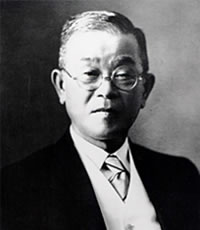
Founder Nezu Kaichiro
The prosperity of the nation
Originating from the path of education
Originating from the path of education
Nezu Kaichiro
Musashi High School was founded by Kaichiro Nezu (The First). He was involved in many railway businesses in Japan, including Tobu Railway and Nankai Railway, and was known as the "Railway King." On the other hand, when he visited the United States as a member of a business group led by Eiichi Shibusawa, he was deeply impressed by the large amount of donations that businessmen made to universities and art museums. With the belief that "the prosperity of a nation originates from the path of education," he also devoted himself to education and culture, such as founding Musashi High School and Nezu Chemical Research Institute. Nezu was also known as a lover of antique art, and was a tea master. After his death, the Nezu Museum (Aoyama, Minato-ku, Tokyo) was established to display his collection. The Nezu Museum is known for its vast Japanese garden, which uses the former site of Nezu's private residence, and for its first-class collection of Japanese and Oriental art in all fields.
Musashi Academy Archives Directions
Musashi Gakuen Archives, located on the second floor Auditorium, collects, organizes and preserves materials related to Musashi Gakuen, and exhibits them to the public.
[Opening hours] Monday to Friday 10:00-16:00 (closed for lunch from 12:30-13:30)
[Opening hours] Monday to Friday 10:00-16:00 (closed for lunch from 12:30-13:30)