
 3S
3S


Studying in Economics and Management Program
Using mathematical formulas to examine the reasons for imposing high tariffs on rice
Understanding trade theory and international finance theory using theoretical models
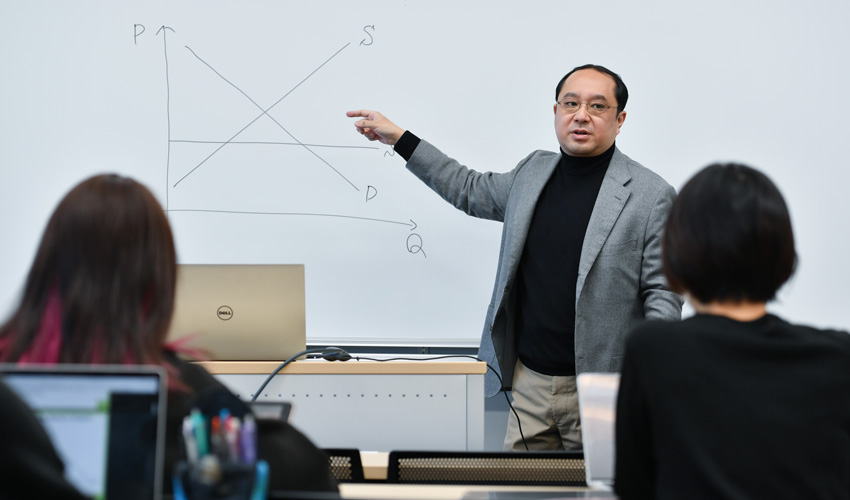
International economics is a field of study that studies the impact that economic connections with other countries have on a country's economy, and is divided into trade theory and international finance theory. Trade theory, which studies the benefits of trade and trade policies, uses microeconomic models to consider "why trade is conducted" and "why trade is restricted." For example, Japan imposes high tariffs on rice, but if other countries can produce rice of the same quality as Japan at a lower price, consumers would be happier if the tariffs were abolished and rice was imported at a lower price. And why are people opposed to lowering tariffs, when Japan could become wealthier by focusing on the production of goods (goods and services) such as automobiles, in which Japan has an advantage over rice?
On the other hand, international finance studies currency and exchange rates using models from macroeconomic theory. Developed countries such as Japan maintain the independence of their monetary policy by adopting a floating exchange rate system in which exchange rates are determined by market supply and demand. However, can we really say that Japan has maintained the independence of its monetary policy in a situation where the interest rate gap between Japan and the United States is widening and the yen is rapidly depreciating?
A theoretical model is a set of mathematical expressions that express the relationships between economic variables by extracting particularly important elements from the real economy. International economics uses such models as a framework for analysis and consideration.
On the other hand, international finance studies currency and exchange rates using models from macroeconomic theory. Developed countries such as Japan maintain the independence of their monetary policy by adopting a floating exchange rate system in which exchange rates are determined by market supply and demand. However, can we really say that Japan has maintained the independence of its monetary policy in a situation where the interest rate gap between Japan and the United States is widening and the yen is rapidly depreciating?
A theoretical model is a set of mathematical expressions that express the relationships between economic variables by extracting particularly important elements from the real economy. International economics uses such models as a framework for analysis and consideration.
Acquire economic thinking through world-class lectures

The curriculum for the PDP's "International Economics" class is based on subject guides created by the University of London and foreign textbooks. In international economics, the main focus is on learning the theoretical models of trade theory and international finance theory using the original texts that are most widely used around the world.
In the exam, students must mathematically solve real-world economic phenomena using a theoretical model, and write an essay examining the validity of the model's explanation. Of course, it is all in English. I have also taught economics at an American university, but the standards set by the University of London (LSE) are so high that I thought, "This is all I can ask of an undergraduate."
For those of us living in this age of globalization, knowledge of international economics is essential to understanding the real economy and policies. On top of that, students will learn about the core theoretical models in trade theory and international finance theory, and explain which models apply to various economic phenomena. By repeating this training, we hope that students will acquire an economic way of thinking.
For those of us living in this age of globalization, knowledge of international economics is essential to understanding the real economy and policies. On top of that, students will learn about the core theoretical models in trade theory and international finance theory, and explain which models apply to various economic phenomena. By repeating this training, we hope that students will acquire an economic way of thinking.
Professor Yui Suzuki
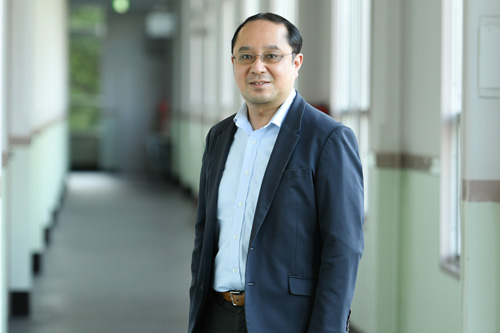
Graduated from Faculty of Economics at the University of Tokyo. After working at the Export-Import Bank of Japan and the Japan Bank for International Cooperation, he obtained a Ph.D. in Economics from the University of Michigan. After serving as an assistant professor at Seton Hall University and an associate professor Faculty of Economics Musashi University University, he assumed his current position in 2017. His specialties include international economics and development economics.