
 3S
3S


Economics, Management and International Relations Program (EMIR Major) / Business Data Science Program (BDS Major) Research Close-up
- Economics, Management and International Relations Program (EMIR Major)
- Business Data Science Program (BDS Major)
The impact of policy, work, and living time on health and well-being
Research
My research field is applied microeconomics, focusing on healthcare and labor, and I study individual decision-making regarding health investment and labor supply using economic frameworks. We also examine the impact of economic policies on health status and employment outcomes, such as drinking behavior, attendance status, and overall well-being of workers, as well as the relationship between the formation of consumption behavior and living time across the life cycle. The current research theme is the impact of commuting time on time allocation and happiness between spouses.
The findings of such research are reflected in policy discussions around minimum wage, policies related to commuting times, and strategies to address gender inequality within households. I want to deepen research on household consumption, time usage patterns, and gender inequality in Japan.
The findings of such research are reflected in policy discussions around minimum wage, policies related to commuting times, and strategies to address gender inequality within households. I want to deepen research on household consumption, time usage patterns, and gender inequality in Japan.

Seminar
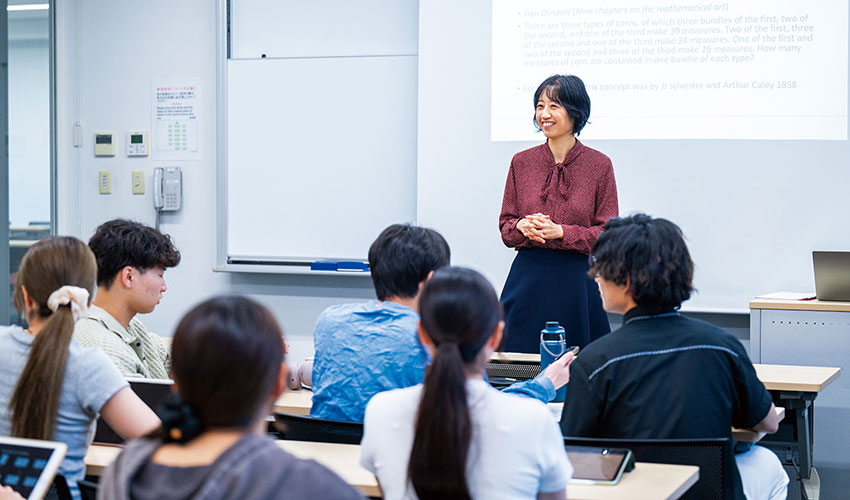
My courses are for the first-year BSc courses "Mathematics 1 and Statistics 1" and "Introduction to Mathematical Statistics." Classes will consist of two parts: lectures and exercises.
The lecture provides a detailed explanation of basic concepts and methods, along with examples of their application. In the exercises, tasks are assigned individually or in groups, and explanations are provided as needed. Working on assignments outside of class academic learning deepens your understanding even further.
Mathematical skills are essential to understand both microeconomic and macroeconomic models, such as corporate optimization decision models and the impact of fiscal and monetary policies. For students majoring in economics and data science, the statistical concepts I learn in my classes form the foundation for Specialized Courses studies such as econometrics, advanced statistics, and machine learning.
The lecture provides a detailed explanation of basic concepts and methods, along with examples of their application. In the exercises, tasks are assigned individually or in groups, and explanations are provided as needed. Working on assignments outside of class academic learning deepens your understanding even further.
Mathematical skills are essential to understand both microeconomic and macroeconomic models, such as corporate optimization decision models and the impact of fiscal and monetary policies. For students majoring in economics and data science, the statistical concepts I learn in my classes form the foundation for Specialized Courses studies such as econometrics, advanced statistics, and machine learning.
Juan Du Professor
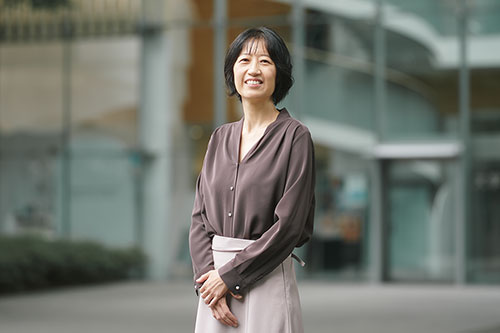
Completed doctoral studies at the University of California, Davis. He holds a PhD in Economics. After working at several academic institutions in the United States, he joined Musashi University. His specialties are health and labor economics.
Aiming to enhance the reliability and reproducibility of machine learning models and establish new statistical methods
Research
Machine learning, which I specialize in, is a branch of AI that trains computers on data and gradually improves their performance. AI is transforming science, healthcare, the economy, and society itself, supporting a wide range of technologies from medical diagnostic systems to image recognition and humanoid robots. Machine learning and AI are driving much of today's innovation. What particularly interests me are model evaluation and selection, statistical learning theory, practical application of supervised learning algorithms, and reproducibility of computer experiments. My research can be applied to various fields using computational statistics and machine learning, mainly for analysis and knowledge extraction from high-dimensional data. The applied research focuses on building predictive models from large semi-structured and heterogeneous datasets, while simultaneously advancing theoretical studies on new statistical methods for evaluating classifiers. The ultimate goal is to establish more advanced methodologies to enhance the reliability and reproducibility of machine learning models.

Seminar
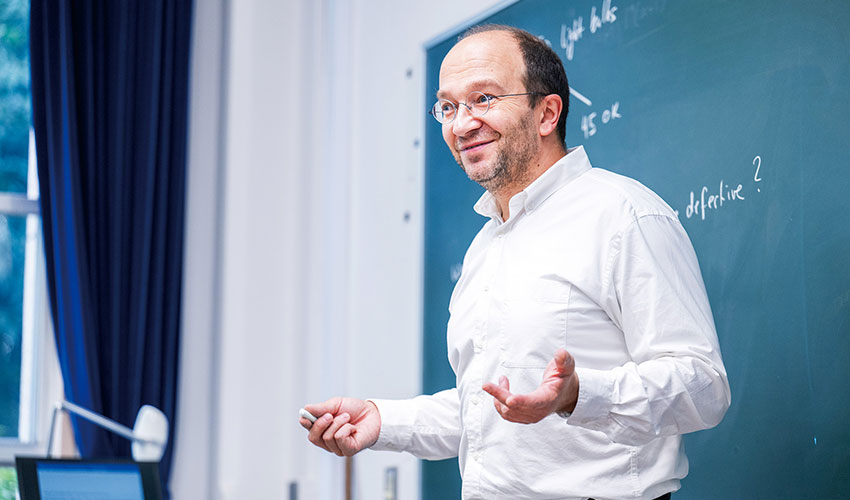
Musashi University I teach PDP courses "Machine Learning" and "Advanced Statistics: Distribution Theory and Statistical Inference." The classes combine theory and practice, teaching the mathematical foundations of algorithms and statistical methods, while also conducting exercises using real data to help students understand how abstract concepts are put into practice. We expect students to engage in critical thinking and approach data with curiosity and a rigorous scientific perspective. I hope you will acquire valuable advanced statistics and machine learning skills in my classes, and confidently tackle complex analytical challenges in research or the workplace.
Daniel Berrar Professor

| 2004 | Completed doctoral program at Ulster University, UK |
| 2017-2022 | Specially Appointed Associate Professor at Tokyo Institute of Technology |
| 2022-2025 | Lecturer in Statistics and Data Science, Open University of the UK Specialization: Machine Learning |
- See close-ups of research in other majors as well
- Global Studies Program Research Close-up