
 3S
3S


Project Objective
Since its founding, Musashi University has had a tradition of focusing on education through small-group "seminars" where students are encouraged to research and think for themselves, and this "inter-faculty seminar project" is a further development of that tradition.
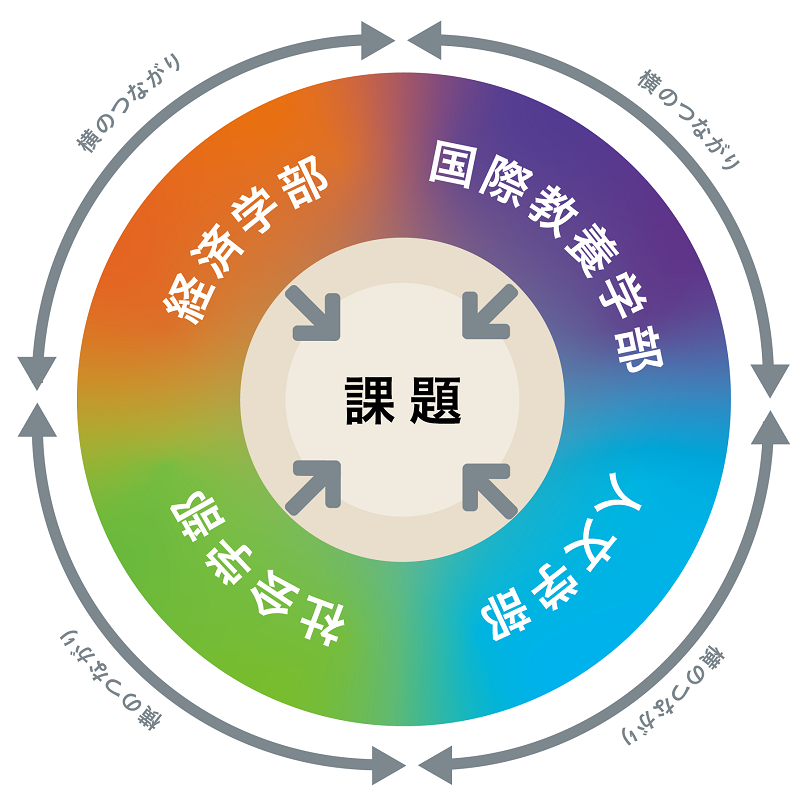
Students from different faculties form teams, share the expertise of their respective faculties, and are given problems that cannot be solved without collaboration. This helps them recognize the importance of "horizontal connections" and aims to improve self-management, teamwork, leadership, and lifelong learning abilities.
Students from different faculties form teams, share the expertise of their respective faculties, and are given problems that cannot be solved without collaboration. This helps them recognize the importance of "horizontal connections" and aims to improve self-management, teamwork, leadership, and lifelong learning abilities.
Forming a team across faculties to tackle a single issue
Mission 1
By having students from multiple faculties with different expertise and values work together toward a single project, they develop a type of teamwork, leadership, and self-management that they would not experience in a seminar within the same faculty.
Mission 2
Throughout the project, various evaluation tools will be used, activities will be recorded on social media (blogs), and career counseling will be provided before, during, and after the project. The aim is not just to solve problems, but to develop the ability to "accurately evaluate oneself," which will lead to lifelong learning.
Mission 3
Through the assignment of "proposals for social issues," participants will be able to look at social activities from the perspective of members of society from within a company and realize the significance and difficulty of fulfilling "social responsibility."
By having students from multiple faculties with different expertise and values work together toward a single project, they develop a type of teamwork, leadership, and self-management that they would not experience in a seminar within the same faculty.
Mission 2
Throughout the project, various evaluation tools will be used, activities will be recorded on social media (blogs), and career counseling will be provided before, during, and after the project. The aim is not just to solve problems, but to develop the ability to "accurately evaluate oneself," which will lead to lifelong learning.
Mission 3
Through the assignment of "proposals for social issues," participants will be able to look at social activities from the perspective of members of society from within a company and realize the significance and difficulty of fulfilling "social responsibility."
Musashi University 's Educational Philosophy and Interdisciplinary Seminar Project
This project takes advantage of the educational philosophy of Musashi University and the location of all students of the four faculties of Faculty of Economics, Faculty of Humanities, Faculty of Sociology, and School of Liberal Arts and Sciences studying on the same campus, and has built a system that allows students to learn the strengths and different ways of thinking of other faculties without being bound by the boundaries of their own faculties, while also reaffirming the expertise of their own faculties.
Musashi University takes the The Three Founding Principles of its founding as the starting point of its education, and in accordance with the philosophy of "Liberal Arts & Science", the basic goal of education is to cultivate Comprehensive Knowledge, Specialized Knowledge, and the ability to collaborate with others and practical skills. It is built so that students can realize how their specialty is useful to society and how it can be utilized by practicing the PBL* learning method in response to challenges from companies while making use of the "knowledge" they have learned at university.
The challenge is "proposals for issues surrounding companies". In the first half of the semester, we will analyze the characteristics of each faculty and report at the mid-term presentation. In the second half, we will form a cross-faculty team, and based on the results of the survey of each faculty in the first half, we will collaborate to clarify the social role played by the company in charge and create a booklet that proposes what kind of future we should create through the company. At the final debriefing session, companies are invited to present the final results.
* PBL=Project-based-learning
Musashi University takes the The Three Founding Principles of its founding as the starting point of its education, and in accordance with the philosophy of "Liberal Arts & Science", the basic goal of education is to cultivate Comprehensive Knowledge, Specialized Knowledge, and the ability to collaborate with others and practical skills. It is built so that students can realize how their specialty is useful to society and how it can be utilized by practicing the PBL* learning method in response to challenges from companies while making use of the "knowledge" they have learned at university.
The challenge is "proposals for issues surrounding companies". In the first half of the semester, we will analyze the characteristics of each faculty and report at the mid-term presentation. In the second half, we will form a cross-faculty team, and based on the results of the survey of each faculty in the first half, we will collaborate to clarify the social role played by the company in charge and create a booklet that proposes what kind of future we should create through the company. At the final debriefing session, companies are invited to present the final results.
* PBL=Project-based-learning
The purpose of this project
Through researching various issues surrounding companies and producing booklets, students themselves aim to be aware of the role they should play in building a sustainable society as citizens. In addition, through activities to come into contact with students from other faculties and their specialties that they did not know before, and to collaborate to create a single thing, students can learn about different ways of thinking and values, and acquire the "diverse perspectives" necessary for living in the real world. In addition, through the class, you can communicate with people from actual companies, so it will be an opportunity to learn more about the real world. In today's world, where the gap between university expertise and the real world is considered a problem, this project is designed with the aim of becoming a "bridge" between the two to apply their expertise in society while feeling the expertise of the university.
Benefits as a learning experience
This seminar was designed solely for the students' learning, and its career support aspect of providing a simulated experience of the real world is secondary. It is based on the following ideas:
In this seminar, you will be directly exposed to the "learning" of other faculties that you do not usually know much about, so mutual understanding is necessary. By learning about different fields, you can confirm the significance of your own "specialty" that you have not been strongly aware of until now. When dividing up the work, you will clearly be aware of what you can do and what you can leave to others and get help with. At Musashi University University, we want students to acquire a balanced combination of Comprehensive Knowledge, Specialized Knowledge, the ability to collaborate with others, and practical skills through a liberal arts and science education. Therefore, we do not want students to graduate with a vague sense of university "knowledge." Rather, we hope that students will confirm the significance of their own specialty and solidify their foothold with pride.
In this seminar, you will be directly exposed to the "learning" of other faculties that you do not usually know much about, so mutual understanding is necessary. By learning about different fields, you can confirm the significance of your own "specialty" that you have not been strongly aware of until now. When dividing up the work, you will clearly be aware of what you can do and what you can leave to others and get help with. At Musashi University University, we want students to acquire a balanced combination of Comprehensive Knowledge, Specialized Knowledge, the ability to collaborate with others, and practical skills through a liberal arts and science education. Therefore, we do not want students to graduate with a vague sense of university "knowledge." Rather, we hope that students will confirm the significance of their own specialty and solidify their foothold with pride.