
 3S
3S


Chinese Language Learning Guide
- What kind of country is "China"?
- What is "Chinese"?
- The importance of learning Chinese
- "Pronunciation and Simplified Characters: Tones and Pinyin"
- Chinese dictionary
- Major qualification examinations and study abroad programs
- Short-term/long-term study abroad
What kind of country is "China"?
In Japan's neighboring country, China, various dynasties have risen and fallen throughout history.
Its current official name is the "People's Republic of China." It was founded on October 1, 1949 (in fact, in China, this day is called National Day).
Its land area is about 9.6 million square kilometers, the third largest in the world after Russia and Canada, and about 26 times that of Japan. Its population is about 1.3 billion people, which is of course the largest in the world. Politically, China has adopted a socialist system, and its administrative divisions are 22 provinces (excluding Taiwan), 5 autonomous regions, the capital Beijing, 4 direct-controlled municipalities of Shanghai, Tianjin, and Chongqing, and 2 special administrative regions of Hong Kong and Macau. It is a multi-ethnic country with 55 ethnic minorities, including the Han people (called Han in China), who make up over 90% of the population. The main language is Chinese, and the unit of currency is the yuan (1 yuan is about 14 yen).
What is "Chinese"?

Needless to say, the most widely used language in the world is English. However, one in five people in the world is actually "Chinese." Chinese is undoubtedly the language with the largest number of speakers among all the world's languages.
The "Chinese" we learn is usually called "Hànyŭ" (Han language) in China. This originally meant the language of the Han people, even in the multi-ethnic country of China. However, this "Chinese" itself has a large difference and a variety of dialects, so that it is generally divided into seven major dialect areas. There are other names for it in technical terms, but it is commonly called Shanghainese, Hokkien, Cantonese, Hakka, etc. For this reason, a common language equivalent to the standard language of Japan is absolutely necessary. So, the common language called "Putonghua" (pŭtōnghuà) that you will learn from now on was created based on the Beijing dialect, and it is widely understood throughout the country (Putonghua is said to have been created based on the language called Beijing Mandarin, which was originally spoken by Beijing bureaucrats during the Qing Dynasty. In Taiwan, it is usually called Beijing dialect (national language) and is also widely studied in school education).
Chinese is known linguistically as an isolated language, and as a rule, each Chinese character (i.e., one syllable) has a specific meaning, and sentences are made up of these characters combined in a set word order. This is very different from Japanese and from Western languages. For example, there are no conjugations or case changes like those in English, German, or French, nor do they have things like Japanese particles and auxiliary verbs. In addition, as will be explained in more detail later, Chinese is known for its complex pronunciation, with different meanings depending on the rise and fall of a sound, something called "tones."
The importance of learning Chinese
As mentioned earlier, one in five people in the world is "Chinese". "Chinese" is the language with the largest number of users in the world. It is spoken not only in the People's Republic of China, but also by people in Taiwan and many overseas Chinese (so-called overseas Chinese) (including dialects). This fact alone makes it very meaningful to learn Chinese.
Furthermore, while still adhering to its socialist system, China is currently experiencing astonishing economic development under policies such as the socialist market economy and reform and opening up. China is not only a political power in Asia, but is also known as the world's factory, and is no longer something that can be ignored economically. Economic, social, and personal exchanges with Japan are also increasing day by day. In the future, young people who are setting out on the world stage will likely have more opportunities than ever to actually use Chinese.
Historically, Japan and China have had a particularly deep relationship. As mentioned earlier, Japanese and Chinese are originally different languages, but we share the medium of Chinese characters. As Japan, Korea, and other nations are sometimes called the "Chinese cultural sphere" or the "Chinese character cultural sphere," our country has received great cultural benefits from China. Knowledge of Chinese will be of great use when considering Japanese history and culture. In addition, in the midst of the trend toward pluralization and diversification in the world, there is much significance in learning Asian languages in addition to Western languages such as English. Learning a language is the best way to build a true partnership with your neighbors.
"Pronunciation and Simplified Characters: Tones and Pinyin"
The first step in learning Chinese is to master the correct pronunciation.
Japanese beginners tend to overlook this point because they can read Chinese characters easily. As a result, there are even cases where learning pronunciation becomes a stumbling block. In modern China, Chinese characters are written in a simplified style called "simplified characters" (jiăntǐzí), and many of them have different meanings from Japanese characters even though they have the same shape. This may seem obvious, but as a purely "foreign language," please make full use of your "ears" and "voice" and aim for a balanced study of "listening, speaking, reading, and writing."
Japanese beginners tend to overlook this point because they can read Chinese characters easily. As a result, there are even cases where learning pronunciation becomes a stumbling block. In modern China, Chinese characters are written in a simplified style called "simplified characters" (jiăntǐzí), and many of them have different meanings from Japanese characters even though they have the same shape. This may seem obvious, but as a purely "foreign language," please make full use of your "ears" and "voice" and aim for a balanced study of "listening, speaking, reading, and writing."
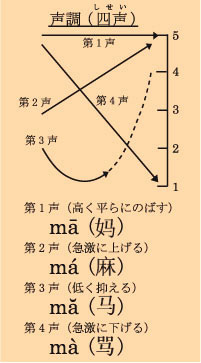
The first thing to learn about Chinese pronunciation is the "four tones." Tones are the rising and falling tones of a sound. In Chinese, one character (syllable) is generally pronounced with a certain tone. In Mandarin, there are four tones, which are called the four tones. Depending on the difference between the four tones, the meaning of the same pronunciation can be different, so you need to pay close attention.
You will also need to learn how to read the Chinese romanization "pinyin" (拼音字母), which shows how to read each kanji character. This is equivalent to English phonetic symbols, but since it is Chinese romanization, it should not be read as if it were Japanese romanization. There are some difficult pronunciations that do not exist in Japanese, but you should practice patiently, thinking of it as studying music. Once you can pronounce pinyin correctly, when you are learning Chinese words, try to memorize this pinyin together with the kanji (simplified characters), just as you would memorize the English spelling.
You will also need to learn how to read the Chinese romanization "pinyin" (拼音字母), which shows how to read each kanji character. This is equivalent to English phonetic symbols, but since it is Chinese romanization, it should not be read as if it were Japanese romanization. There are some difficult pronunciations that do not exist in Japanese, but you should practice patiently, thinking of it as studying music. Once you can pronounce pinyin correctly, when you are learning Chinese words, try to memorize this pinyin together with the kanji (simplified characters), just as you would memorize the English spelling.
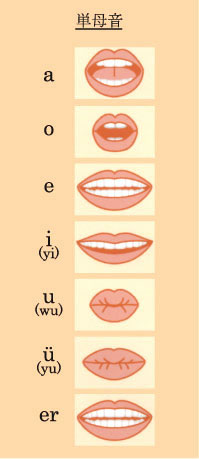
Now, in Japanese there are only five vowels: aiueo.
As you know, the 50 sounds of the Japanese alphabet are made up of a combination of these and consonants. In comparison, Chinese pronunciation is far more complicated. First of all, there are seven basic "simple vowels", but the pronunciation is quite different from Japanese, including the way you open your mouth. Furthermore, there are several "polyvowels" that combine these. The pronunciation of consonants is also very different from Japanese. As the table shows, there are many things that must be mastered, such as the difference between aspirated and unaspirated sounds, and what are called retroflex consonants.
In this way, Chinese is, in a sense, a very musical language. Some Western scholars have pointed this out. Many people have trouble with pronunciation at first, but as they listen, they become fascinated by the unique sound. Of course, understanding the structure of grammar is important, but the key is to learn the language using not only your head but your whole body - this is the basis of learning any foreign language, not just Chinese.
Chinese dictionary
For beginners and intermediate learners, there are Chinese dictionaries and Chinese-Japanese dictionaries such as the following.
- "First Chinese Language Learning Dictionary" (Asahi Publishing)
- "Progressive Chinese Dictionary" (Shogakukan)
- "Daily Concise Chinese-Japanese Dictionary" (Sanseido)
- "Crown Chinese-Japanese Dictionary" (Sanseido)
- "Standard Chinese Dictionary" (Hakuteisha)
- "Iwanami Chinese Dictionary" (Iwanami Shoten)
If you wish to study more advancedly, it may be useful to have the following dictionaries on hand:
- "Chinese-Japanese Dictionary" (Kodansha)
- "Chinese-Japanese Dictionary" (Shogakukan)
- "Hakusuisha Chinese Dictionary" (Hakusuisha)
- "Modern Chinese Dictionary" (Koseikan)
- "Oriental Chinese Dictionary" (Touhou Shoten)
- "Chinese-Japanese Dictionary" (Taishukan Shoten)
For more advanced students, make full use of Japanese-Chinese dictionaries published by various companies (Iwanami Shoten, Kodansha, Shogakukan, etc.), as well as Chinese character dictionaries such as the Xinhua Dictionary and dictionaries published in China such as the Modern Chinese Dictionary (both published by Commercial Press) to master the nuances of Chinese and for writing.
For a general understanding of the situation in modern China, useful references include Asian Reader: China (edited by Zeng Zicai, Nishizawa Haruhiko, and Segawa Masahisa, published by Kawade Shobo Shinsha), China: What I Want to Know More About I and II (edited by Nomura Koichi, Takahashi Mitsuru, and Tsuji Kogo, published by Kobundo), and The Han People and Chinese Society (edited by Hashimoto Mantaro, published by Yamakawa Publishing).
For a general understanding of the situation in modern China, useful references include Asian Reader: China (edited by Zeng Zicai, Nishizawa Haruhiko, and Segawa Masahisa, published by Kawade Shobo Shinsha), China: What I Want to Know More About I and II (edited by Nomura Koichi, Takahashi Mitsuru, and Tsuji Kogo, published by Kobundo), and The Han People and Chinese Society (edited by Hashimoto Mantaro, published by Yamakawa Publishing).
Major qualification examinations and study abroad programs
- Practical Chinese Proficiency Test
- Asia International Exchange Scholarship Foundation, approved by the Ministry of Education, Culture, Sports, Science and Technology (Levels 1-5)
- HSK/Chinese horizontal exam
- It was created by the Beijing Language and Culture University with the purpose of measuring the Chinese language proficiency of foreign students who are not native Chinese speakers, but it has also been approved by the National Council of Education, which is equivalent to the Ministry of Education, Culture, Sports, Science and Technology in Japan, and can be taken in Japan. It is required for studying abroad at a four-year university (undergraduate course) in China, and can be considered the equivalent of TOEFL® in English-speaking countries.
- Chinese Language Proficiency Test
- This is a Chinese language proficiency test conducted by the Taiwan Chinese Literature Proficiency Testing Promotion Committee, and is available in levels 1 to 4. It can be taken in Taiwan and Japan. English name is TOCFL. It is recommended for students who have undergone language training at a university in Taiwan or who are considering studying abroad in Taiwan.
■ Musashi University Foreign Language Learning Award and encouragement are applicable to the Practical Chinese Proficiency Test/HSK/Chinese Language Qualification Examination/Chinese Literature Proficiency Test depending on the passing level.
Short-term/long-term study abroad
Musashi University has signed a Study Abroad through University Agreement program with Xi'an International Studies University in China since 2006, and in addition to a one-year exchange program, a short-term language training program is operated during the spring vacation. In addition, from the 2013 academic year, a Study Abroad through University Agreement system was signed with National Chengchi University in Taiwan, and in addition to a one-year exchange program, a short-term language training program held during the summer vacation will be launched. You can choose between China and Taiwan, and the duration is long-term or short-term, so it is a good idea to take advantage of these systems to try your hand at studying abroad.