
 3S
3S


English Learning Guide
- English-speaking countries around the world
- English alphabet
- General greetings
- Origin and History of the English Language
- The importance of learning English
- Recommended dictionaries
- Major examinations and qualifications
English-speaking countries around the world
Today, English-speaking countries are spread all over the world, and it is said that there are about 800 million people who use English as their first language. Representative countries include the United Kingdom, the United States, Canada, Australia, and New Zealand. If you line up the national flags,

As you can see at a glance, the flags of Australia and New Zealand are similar to the British flag. Both countries are members of the Commonwealth (formerly known as the British Commonwealth), and their head of state is Queen Elizabeth (II). Canada, while its flag is not similar, is also a member of the Commonwealth, just like these two countries, and has the same head of state. The Commonwealth has many other member countries, and one in three of the world's total population is a citizen of a Commonwealth member country. The Queen is the head of state for 16 Commonwealth countries, including the three mentioned above.
Although the United States is not a member of the Commonwealth, as a fellow English-speaking power it maintains close ties with these countries in politics, economics, and other areas.
English alphabet
Most European languages belong to the Indo-European language family, and currently each language has its own alphabet, but it is believed that it was originally developed as a logographic script by the Phoenicians, a maritime merchant people in the ancient Mediterranean world, around 1000 BC, based on the North Semitic alphabet. The Greeks and Romans then further developed it, and it spread to each European country. The name "alphabet" comes from the first two letters of the Greek alphabet, "alpha" and "beta."
|
A |
B b |
C c |
D |
E e |
F |
G |
H |
I |
|
J j |
K k |
L |
Mm |
N |
O |
P |
Q q |
R |
|
S |
T |
U u |
V v |
W |
X x |
Y y |
Z z |
|
The Greek Alphabet
We will introduce only the lowercase letters of the Greek alphabet, some of which you will find familiar as symbols in mathematics and the natural sciences.

The Greek translation of "Musashi" is "Mουσασι".
General greetings
| "Hello!" |
Hi! Hello!
|
|---|---|
| "Hello, how are you?" |
How is it going?
How are you?
How's everything?
|
| "Not bad, I guess." |
Not bad. (So-so is Japanese English)
|
| "Same as always." |
Same old, same old.
|
Origin and History of the English Language

Historically, the original inhabitants of present-day Britain were the Celts, who were widely distributed across the European continent and boasted great power. However, as the Roman Empire (centered in present-day Italy) expanded, Julius Caesar from Rome invaded Britain twice, in 55 BC and 54 BC, and Britain became a vassal state in 47 AD, beginning the coexistence of the Romans and Celts. Later, in 410 AD, Germanic peoples invaded the Roman Empire in Europe, and the Roman army withdrew from Britain.
Then, after 499 AD, the Angles, Saxons, and Jutes, a group of Germanic peoples from the European continent, invaded England, settled there, and became isolated from the rest of Europe, at which point the English language is said to have been established. England is a corrupted form of Angles' land. Even today, England is called Angleterre (terre = land) in French, and Anglais in English. The oldest written English can be found in fragments in a royal charter written in Latin (the language of the Romans) around 700 AD. The English of this period is academically called Old English. Its form is very similar to modern German.
Then, in 793 AD, Britain was invaded by Vikings from Scandinavian countries (mainly Denmark), ushering in an era of coexistence of English and Scandinavian languages. Furthermore, in 1066, the country was conquered by the Normans who lived in northern France, and for the next 300 years or so, the lower classes spoke only English, while the upper classes only spoke French.
For this reason, English is called a hybrid language. In other words, simply put, it was originally a dialect of German that was influenced by Celtic, Latin (the language of the Romans, which later developed into French, Italian, Spanish, Portuguese, etc.), Scandinavian, and French. Of course, it goes without saying that Europe was influenced by ancient Greece at the same time as the Roman Empire. Now, let's look at a map of Europe and imagine the influence of other languages on English. After all, Germany, France, Italy, Denmark, and Greece are all close to England.
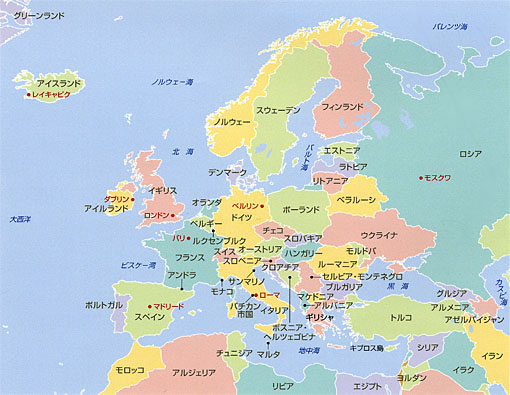
Therefore, the total vocabulary size is roughly twice that of German or French, and although it is a difficult language to learn due to its large vocabulary size, it has the advantage of being able to express even subtle differences in meaning.
The origin of the word is complex and there are many theories about it depending on the time period, but here we will divide the multiple words meaning "street, road" into words of German origin, the ancestor of English, and words of French (Latin) origin.
|
German origin
|
|
way/path/gate
|
|
French (Latin) origin
|
|
Street/avenue/passage/route/alley/trail/meatus
|
The importance of learning English
English connects the world
Today's world has been shaped since the Age of Discovery through the Industrial Revolution, the era of empires and colonies, and two world wars. The reason why English, which was originally the language of one ethnic group in the British Isles, has expanded its influence to the point where it is spoken in many parts of the world today, is because of the history of the world that has been created by the people who use English.
Up until the end of the Tokugawa period, Chinese classical literature and Dutch studies, centered on medicine, were practiced in Japan. However, after visiting various parts of the world, Fukuzawa Yukichi realized that he had to learn English, and it is well known that he wrote an enlightening book for the Japanese of the time and encouraged the learning of English.
Thus, during the new era from the Edo period to the Meiji period, in order to prevent Japan, a small Asian country, from being colonized, people began to learn English as part of national policy.
The world continued to shrink, and by the last decade of the last century, the technology of the Internet had made it easy to access English even in every home.
Through this simple review of world history and Japanese history, we can see that even for many of us who live in Japan and spend our daily lives speaking Japanese, we cannot avoid coming into contact with English. It goes without saying that many katakana words are English. It can be said that learning English is a part of living in the modern era. If you go to an area known as an "English-speaking" area, it is not just convenient to know English, but you will be in trouble if you do not know it.
Up until the end of the Tokugawa period, Chinese classical literature and Dutch studies, centered on medicine, were practiced in Japan. However, after visiting various parts of the world, Fukuzawa Yukichi realized that he had to learn English, and it is well known that he wrote an enlightening book for the Japanese of the time and encouraged the learning of English.
Thus, during the new era from the Edo period to the Meiji period, in order to prevent Japan, a small Asian country, from being colonized, people began to learn English as part of national policy.
The world continued to shrink, and by the last decade of the last century, the technology of the Internet had made it easy to access English even in every home.
Through this simple review of world history and Japanese history, we can see that even for many of us who live in Japan and spend our daily lives speaking Japanese, we cannot avoid coming into contact with English. It goes without saying that many katakana words are English. It can be said that learning English is a part of living in the modern era. If you go to an area known as an "English-speaking" area, it is not just convenient to know English, but you will be in trouble if you do not know it.
Japanese in English
(It gives you a glimpse into the image that British and American people have of Japan...)
|
Harakiri= Harakiri
|
samurai= Samurai
|
Karaoke= Karaoke
|
tycoon= lord, lord
|
|
Tsunami= Tsunami
|
Tofu= tofu
|
kamikaze= [adjective] reckless
|
Ninjutsu= Ninjutsu
|
|
Bonsai= bonsai
|
banzai= Hurrah!
|
Be aware of words
Next, let's look back at our daily lives. Unless something extraordinary happens, we don't think about the fact that we use Japanese in our daily lives (if we were to be obsessed with the usage of Japanese every time, things wouldn't go smoothly). That's how transparent the Japanese language is to us. It's the same as a fish not being aware of the water. However, a fish taken out of water cannot help being aware of the water. In the same way, by learning a foreign language such as English, you will be able to appreciate not only the value of the Japanese language, but also its richness. Of course, this benefit is not limited to English, but as mentioned above, considering the current level of use in the world, learning English will make things more convenient, not inconvenient.
For those of us who live in Japanese, there are at least two major reasons for learning English in this modern age. As we continue to study English at university, it is important to confirm the fundamentals of English study. It may be said that it is a coincidence that we have been born in this world and at this time.
For those of us who live in Japanese, there are at least two major reasons for learning English in this modern age. As we continue to study English at university, it is important to confirm the fundamentals of English study. It may be said that it is a coincidence that we have been born in this world and at this time.
Beyond English: Language, People, and the World

Finally, let's think about how to distance ourselves from English. Anyone can realize the two fundamental things above about our relationship with English if they think about it. However, there are as many ways to distance ourselves from English and attitudes toward English as there are people. There are cases where people want to avoid English as much as possible, and cases where they feel that they cannot realize themselves without English. There are also cases where people focus on the interesting aspects of English as a language, and cases where they must continue to learn English as an indispensable tool in life.
And the important thing is that it is your choice and decision. You have to give meaning to learning English yourself. Even if many people give you advice, how you approach English is ultimately your problem. If you broaden your view of language issues, they lead to the question of how we live as human beings and how we approach the world. The world is created by humans, and the world of English is part of it, so there is both light and shadow. And knowing both more broadly and deeply, rather than just one or the other, gives you the opportunity to become richer by knowing more.
Again, how you approach English is ultimately up to you, the reader of this article. It's easy to become negative. Instead, be positive and make a decision after fully experiencing the world that learning English opens up for you. It won't be a waste of time.
Not only do you want to learn English for its convenience and immediate wealth, but you should also continue to use it as a means and subject of study that will enrich you as a person living in the world, and discover the world and people that exist beyond English.
Again, how you approach English is ultimately up to you, the reader of this article. It's easy to become negative. Instead, be positive and make a decision after fully experiencing the world that learning English opens up for you. It won't be a waste of time.
Not only do you want to learn English for its convenience and immediate wealth, but you should also continue to use it as a means and subject of study that will enrich you as a person living in the world, and discover the world and people that exist beyond English.
Recommended dictionaries
There are countless English-Japanese dictionaries in Japan, making it difficult to choose, but the deciding factor for purchasing a dictionary seems to be that "it contains the meanings of words and expressions that interest me." If I were to recommend a dictionary for learners, I would choose the following two.
- "Genius English-Japanese Dictionary" (Taishukan Shoten)
- It has a reputation for being rich in content, from everyday expressions to grammar, and has been a best-seller for many years.
- "Wisdom English-Japanese Dictionary" (Sanseido)
- This is the first "raw" English dictionary in Japan that uses statistics to extract real usage examples from a large-scale English database.
For those who want to study further, the following two English-English dictionaries are recommended as they are handy and have comprehensive content. Both of them are created based on large-scale English databases.
- Oxford Advanced Learner's Dictionary
- (Oxford University Press)
- Longman Dictionary of Contemporary English
- (Longman)
Recently, I've been asked a lot, "What electronic dictionary do you recommend?" Since new models are constantly coming out, it's difficult to say which one is best, but the models sold at the university co-op are good candidates. Also, for those who are thinking of seriously studying English, I recommend models equipped with the Reader's English-Japanese Dictionary 2nd Edition (Kenkyusha), Reader's Plus (Kenkyusha), Genius English-Japanese Dictionary (Taishukan Shoten), Oxford Advanced Learner's Dictionary, New Edition English-Japanese Usage Dictionary (Kenkyusha), etc. (They are available on Sharp and Casio models).
Major examinations and qualifications (overview of examinations and qualifications that prove proficiency in the language)
A comprehensive information site about Englisheigotown (http://www.eigotown.com/)According to the 2015 IEEE International Conference on English Language Proficiency and English Language Skills (IELTS), there are currently 56 English language proficiency exams available in Japan.STEP (Eiken), assessing the English communication skills required for carrying out business in a companyTOEIC®, assessing the English proficiency required to study at an English-speaking universityTOEFL ®So, what is the relationship between these and your English studies at university?
One reason is that the results of proficiency tests are used as a measure of English ability. Specifically, when applying for a job, a company that wants to assess you from multiple angles may use the results as a guide to your English ability, such as "how many points or what level you got on the ____ test." Some companies, not just foreign-affiliated companies, require a certain score on an English qualification or proficiency test as a qualification requirement (cutoff factor) as part of general academic ability. Therefore, if you want to work for a company that places importance on English, it will be a major requirement for getting a job offer.
Secondly, it is used as a qualification requirement for studying abroad at an educational institution such as a university in an English-speaking country.IELTS™These are the global standard standards for studying at an English-speaking university, and your study abroad destination can be determined by your test scores.
Thirdly, it becomes a concrete goal for each individual in their English studies. For many people, English is not a language they use in their daily lives, so the English skills they have acquired by the time they enroll will deteriorate if they do not continue studying after that. As a way to maintain and further improve their English skills, students can study with the concrete goal of passing an English proficiency test.
Many people have a vague interest in English, but liking it alone will not improve your skills. Use various certification and proficiency tests to objectively understand your current skills and improve them further. If you are interested in general English proficiency tests other than the major tests mentioned above, or certification tests in specialized fields such as interpretation and translation, visit the above site and search for qualifications and proficiency tests that suit your goals.
■Musashi University Foreign Language Learning Award and EncouragementThere are also some certification exams for which this applies.
One reason is that the results of proficiency tests are used as a measure of English ability. Specifically, when applying for a job, a company that wants to assess you from multiple angles may use the results as a guide to your English ability, such as "how many points or what level you got on the ____ test." Some companies, not just foreign-affiliated companies, require a certain score on an English qualification or proficiency test as a qualification requirement (cutoff factor) as part of general academic ability. Therefore, if you want to work for a company that places importance on English, it will be a major requirement for getting a job offer.
Secondly, it is used as a qualification requirement for studying abroad at an educational institution such as a university in an English-speaking country.IELTS™These are the global standard standards for studying at an English-speaking university, and your study abroad destination can be determined by your test scores.
Thirdly, it becomes a concrete goal for each individual in their English studies. For many people, English is not a language they use in their daily lives, so the English skills they have acquired by the time they enroll will deteriorate if they do not continue studying after that. As a way to maintain and further improve their English skills, students can study with the concrete goal of passing an English proficiency test.
Many people have a vague interest in English, but liking it alone will not improve your skills. Use various certification and proficiency tests to objectively understand your current skills and improve them further. If you are interested in general English proficiency tests other than the major tests mentioned above, or certification tests in specialized fields such as interpretation and translation, visit the above site and search for qualifications and proficiency tests that suit your goals.
■Musashi University Foreign Language Learning Award and EncouragementThere are also some certification exams for which this applies.