
 3S
3S


Korean Language Learning Guide
- Let's learn Korean!
- Korean-speaking areas
- The importance of learning Korean
- What kind of language is Korean?
- How to read Hangul and greetings
- Dictionaries and reference books
- Major examinations and qualifications
- Short-term/long-term study abroad
Let's learn Korean!
Many people have traveled to Korea, lured by slogans such as "Let's taste authentic Korean food!" and "Visit the filming locations of Winter Sonata." However, the first thing that Japanese travelers are surprised by is the Hangul characters that overflow on street corner signs. You won't have such an experience when traveling to America, Europe, or China. This is because you can at least read the characters written on signs, even if you don't understand their meaning. Hangul, which looks like a combination of vertical and horizontal lines, dots, and circles to those who don't know it, is a phonetic character created in 1443, but once you learn the rules, it is very easy to read. In addition to reading signs, Korean is the easiest language for those of us who speak Japanese as our native language, as it allows us to string words together to form sentences.
Korean-speaking areas
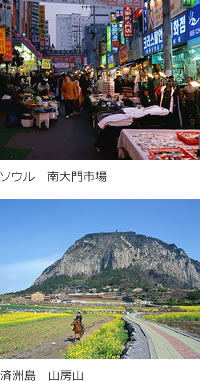
Korean is spoken on the Korean Peninsula, which is next to Japan, and on the surrounding islands. Currently, there are two nations on the Korean Peninsula: the Republic of Korea (South Korea, capital: Seoul) and the Democratic People's Republic of Korea (North Korea, capital: Pyongyang). The population of South Korea is about 48 million, and that of North Korea is about 20 million, for a total of about 68 million people who speak Korean as their native language. In addition to the Korean Peninsula, there are about 2 million Koreans living abroad in the Yanbian Korean Autonomous Region in Jilin Province, China, about 700,000 in Japan, about 1.4 million in the United States, and about 400,000 in Russia, and in some areas the language is taught as an ethnic language. In South Korea, the language is usually called "Korean" (Hanggo, Hangunmal), and in North Korea it is called "Korean language" (Chosonmal). At Musashi University, "Korean" is a combination of these two names. "Hangul" is the name of the characters, not the name of the language itself.
The importance of learning Korean
There are currently many Korean students studying in Japan. A large number of young Japanese people have become attracted to Korea through conversation with them and have begun to study the language. Many people also began studying Korean because they wanted to watch Korean movies and dramas without subtitles. There are also many people who have several Korean songs in their karaoke repertoire. If you start at this stage and delve into the sea of Korean words, you will find that there is a culture, history, and vitality of the people that makes us, who are native Japanese speakers, think about many things. For example, "Nara" in Korean means "country." "Oh, is this possibly Nara?" ... In this way, there are countless reasons to learn this language, both historically as a mirror to consider Japanese language and culture in a relative way, and currently as a means to directly touch the vitality of the people. In recent years, economically, Korean products are competing head-to-head with Japanese products in the automobile and home appliance markets in Europe, America, and other regions. Many people say that their close friends who they made while studying abroad in English-speaking countries were Korean. There are many other reasons and benefits to studying this language, but one of its characteristics may be that it is useful all over the world, and in unexpected situations.
What kind of language is Korean?
Its grammatical structure is said to be similar to that of Japanese and Altaic languages (such as Turkish and Mongolian), but the greatest similarity to Japanese can be seen in the following example sentence.
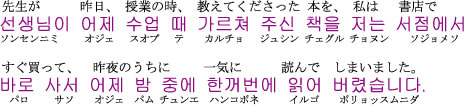
If you try to express a sentence like the one above in English, you have to consider complex steps and word order, such as subject, object, and relative clauses.
However, in Korean, such a procedure is not necessary at all. Simply by connecting nouns, particles, and correctly conjugated verbs and adjectives in the same word order as in Japanese, you can construct a proper sentence like the one above. In the above example sentence, particles such as "te-ni-wo-ha" correspond almost one-to-one. There are also similar conjugations for verbs such as "oshiete," "katte," and "yonde," as well as auxiliary verbs such as "kudasaru" and "shimau." Even the way "oshiete-kudasatta" modifies "hon" (book) and the use of honorifics (kureru → kudasaru) are similar. And above all, a major feature is that Japanese and this language share quite a lot of kanji words. In the above sentence, "sensei," "kyuu," and "shoten" are simply pronounced "seonsaeng (nim)," "suop," and "sojom" in Korean. Also, speaking of Chinese characters, adjectives such as "simple," "bold," and "pure" can be read as "sobakada," "taedamada," and "cheongsunada" in Korean, using the on-reading of the Chinese characters. -What do you think? They are very similar, aren't they? This is probably the result of both Japanese and Korean having been deeply influenced by Chinese character culture. "But Hangul is still difficult..."
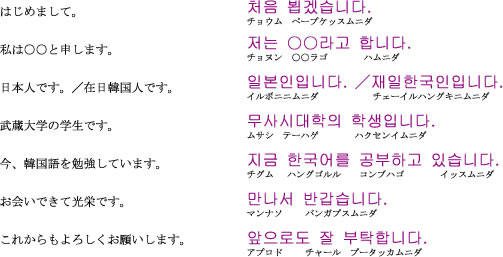
How to read Hangul and greetings
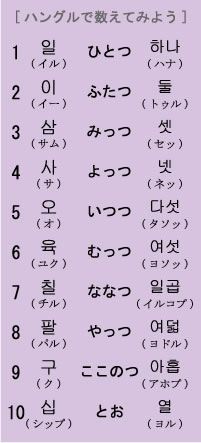
I see. Well, for those people, I will briefly introduce how to read Hangul and greetings.
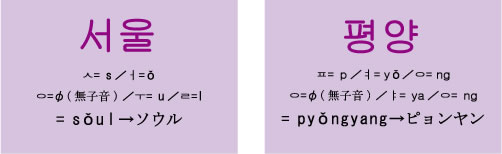
Dictionaries and reference books
dictionary
- Korean Dictionary (Shogakukan) Edited by Yukitoshi Aburaya et al.
- "Completely revised Korean-Japanese dictionary" (Sanshusha), edited by Yasuda Yoshimi et al.
The two books above have an appropriate number of vocabulary words and are recommended for those who wish to continue studying in the future.
- "Cosmos Chosa-Japanese Dictionary" (Hakusuisha), edited by Hiroomi Kanno et al.
The explanations of basic vocabulary are very thorough, but this alone is not enough to read newspapers or magazines.
Reference book
- "The Future of Korean" (2 CDs, Sanshusha, 2007) by Kwon Jae-suk
- "Introduction to Korean" (Hakusuisha, 2007) by Hiroomi Kanno
- "Standard Hangul Lecture" (5 volumes, Taishukan Shoten, 1989-1991) Edited by Hiroyuki Umeda
- "New Edition Korean Grammar Dictionary" (Sanshusha, 2004) by Mineko Shirai (translated by Ooi and supervised by Noma)
Books to learn about Korea and the Korean language
This mini-encyclopedia explains people and matters related to all fields, from culture, history, folklore, and religion to food, clothing, shelter, politics, and economics, and is a must-have book for anyone studying this topic.
This is a textbook for NHK's language programs. Classes are held every April and October. The introductory radio course in particular will allow you to steadily improve your skills with four sessions per week.
Major examinations and qualifications
There are currently three types of exams of this type that can be taken in Japan:
The Hangul Proficiency Test is administered by the Hangul Proficiency Association and includes both South and North Korean spelling systems. There are seven levels, ranging from Level 5 (beginner) to Level 1 (highest level), with Level 2, Level 1, etc. in between.
Under the Ministry of Education of KoreaKorea Education FoundationThe test is conducted by the Ministry of Education, Culture, Sports, Science and Technology and has six ranks, from Level 1 (beginner) to Level 6 (highest level).
Affiliated organization of the Ministry of Land, Infrastructure, Transport and Tourism of JapanJapan National Tourism OrganizationThis is an exam conducted by the Japan Tourism Agency. Since it is an exam for guides who deal with tourists coming to Japan, in addition to language ability, questions on Japanese geography, history, general knowledge, etc. are also included.
■The Hangul Proficiency Test/Korean Proficiency Test applies Musashi University Foreign Language Learning Award and Encouragementapplies.
Short-term/long-term study abroad
After acquiring basic language skills, try studying abroad in Korea for a short period (one month) or long term (one year).
Musashi University is tying Partnership AgreementKorea Universityis a prestigious private university in Seoul, the capital of Korea, that has been sending out excellent people to various fields since its founding in 1905. It is a comprehensive university with faculties such as literature, political science and economics, business administration, law, teacher training (education), medicine, and science and engineering. Exchange Students (long-term = 1 year) dispatched from Musashi University University can take Korean language courses while also taking classes in the Japanese Literature Department, Japanese Literature Department (Korean language literature department), History Department (which also has classes on Japanese history), and more. If they wish, they can also take classes in Korea University's flagship faculties of law and medicine, computer engineering classes in the science and engineering department, and physical education education department (education college) where many famous athletes come from.
In addition, short-term study abroad (1 month) at the same university Korean Language and Culture Education CenterYou can take Korean language training courses taught by highly qualified instructors.
Whether long-term or short-term, the credits and grades you earn during your study abroad period may be recognized as graduation credits from Musashi University after you return to Japan.
Musashi University is tying Partnership AgreementKorea Universityis a prestigious private university in Seoul, the capital of Korea, that has been sending out excellent people to various fields since its founding in 1905. It is a comprehensive university with faculties such as literature, political science and economics, business administration, law, teacher training (education), medicine, and science and engineering. Exchange Students (long-term = 1 year) dispatched from Musashi University University can take Korean language courses while also taking classes in the Japanese Literature Department, Japanese Literature Department (Korean language literature department), History Department (which also has classes on Japanese history), and more. If they wish, they can also take classes in Korea University's flagship faculties of law and medicine, computer engineering classes in the science and engineering department, and physical education education department (education college) where many famous athletes come from.
In addition, short-term study abroad (1 month) at the same university Korean Language and Culture Education CenterYou can take Korean language training courses taught by highly qualified instructors.
Whether long-term or short-term, the credits and grades you earn during your study abroad period may be recognized as graduation credits from Musashi University after you return to Japan.