
 3S
3S


Liberal Arts and Sciences
Liberal arts and sciences education that builds on expertise and allows students to acquire a wide range of knowledge and skills
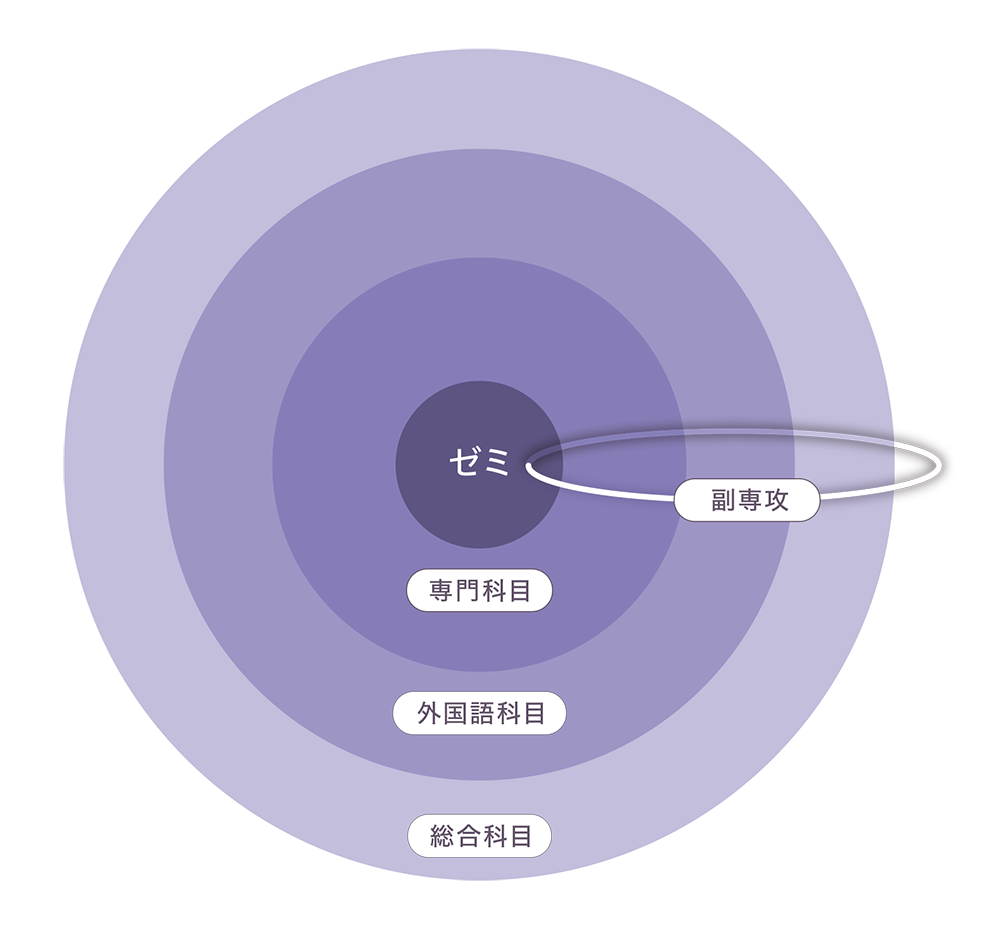
Musashi University 's curriculum consists of "General Education Courses," "Foreign Language Courses," and "General Education Courses Specialized Courses," with Specialized Courses at its core. Liberal Arts & Sciences learning is a cross-sectional combination of these Foreign Language Courses subjects.
All students can take University-Wide Specialized Courses and Interdepartmental Specialized Courses, which are classified as "Specialized Courses," and they foster advanced knowledge and practical skills that transcend the boundaries of specialization. Furthermore, "minor courses" are units that reinforce Specialized Knowledge and encourage cross-faculty exchange. Meanwhile, "General Education Courses" and "Foreign Language Courses" are primarily introductory courses, and a considerable number of "Foreign Language Courses" are required. However, some Elective subjects cover advanced content. The number of possible combinations is countless, and Musashi University 's liberal arts and sciences curriculum allows students to learn in a variety of ways, depending on their interests.
All students can take University-Wide Specialized Courses and Interdepartmental Specialized Courses, which are classified as "Specialized Courses," and they foster advanced knowledge and practical skills that transcend the boundaries of specialization. Furthermore, "minor courses" are units that reinforce Specialized Knowledge and encourage cross-faculty exchange. Meanwhile, "General Education Courses" and "Foreign Language Courses" are primarily introductory courses, and a considerable number of "Foreign Language Courses" are required. However, some Elective subjects cover advanced content. The number of possible combinations is countless, and Musashi University 's liberal arts and sciences curriculum allows students to learn in a variety of ways, depending on their interests.
Liberal Arts and Sciences Concept Diagram
Learning Points
POINT 1
Creating new perspectives through the exchange of "Specialized Knowledge" and "Comprehensive Knowledge"
The purpose of studying liberal arts and sciences is to acquire "Comprehensive Knowledge" and exchange "Specialized Knowledge." As a result, students acquire a wide range of knowledge and skills, and dialogue between specialties is realized. Minor majors also supplement the "Specialized Knowledge" of faculties, departments, and majors, and cultivate additional expertise. Interdisciplinary exchange of knowledge will broaden your horizons and help you see different ways of solving problems.
The purpose of studying liberal arts and sciences is to acquire "Comprehensive Knowledge" and exchange "Specialized Knowledge." As a result, students acquire a wide range of knowledge and skills, and dialogue between specialties is realized. Minor majors also supplement the "Specialized Knowledge" of faculties, departments, and majors, and cultivate additional expertise. Interdisciplinary exchange of knowledge will broaden your horizons and help you see different ways of solving problems.

What are "Specialized Knowledge" and "Comprehensive Knowledge"?
"Specialized Knowledge" refers to knowledge specific to a particular field, such as finance or psychology. On the other hand, "Comprehensive Knowledge" is knowledge that looks at the whole picture and integrates individual things. If a student in the Faculty of Faculty of Economics studies literature and history and gains the ability to understand society from a bird's-eye view, that ability is "Comprehensive Knowledge."
"Specialized Knowledge" refers to knowledge specific to a particular field, such as finance or psychology. On the other hand, "Comprehensive Knowledge" is knowledge that looks at the whole picture and integrates individual things. If a student in the Faculty of Faculty of Economics studies literature and history and gains the ability to understand society from a bird's-eye view, that ability is "Comprehensive Knowledge."
POINT 2
Emphasis on "Integration of Humanities and Sciences" to acquire multifaceted knowledge
In today's society, where various phenomena are intricately intertwined, multifaceted knowledge that Integration of Humanities and Sciences is required. In light of this reality, the "Nature and Environment" section of General Education Courses offers physics, chemistry, and biology, and science subjects are also offered in the university University-Wide Specialized Courses and Interdepartmental Specialized Courses. Please engage in broad and deep learning of liberal arts and sciences.
In today's society, where various phenomena are intricately intertwined, multifaceted knowledge that Integration of Humanities and Sciences is required. In light of this reality, the "Nature and Environment" section of General Education Courses offers physics, chemistry, and biology, and science subjects are also offered in the university University-Wide Specialized Courses and Interdepartmental Specialized Courses. Please engage in broad and deep learning of liberal arts and sciences.
POINT3
Developing foreign language skills to survive in a globalized world
The reason why "foreign languages" are included in the study of Liberal Arts and Sciences is because active foreign language study is essential to acquire intercultural understanding and communication skills to live in a globalized age. Musashi University offers a wide range of options, including not only English, but also German, French, Italian, Spanish, Chinese, and Korean.
Pick-up Classes
Classes on social sciences, natural sciences, and physical education that broaden your knowledge
PICK UP class 1
—Challenges facing modern Japan—
Is the future bright for AI, robots and humans?
Artificial intelligence (AI) is being used in all areas of human life. In this class, we will take up topics ranging from the invisible programs (algorithms) embedded in social media to humanoid robots, overview the activities of AI and robots, and consider how they can coexist with humans, or if they cannot.
Is the future bright for AI, robots and humans?
Artificial intelligence (AI) is being used in all areas of human life. In this class, we will take up topics ranging from the invisible programs (algorithms) embedded in social media to humanoid robots, overview the activities of AI and robots, and consider how they can coexist with humans, or if they cannot.
PICK UP class 2
—Sports history and culture—
What kind of culture is sports for humans?
Sports are closely intertwined with our lives and continue to develop. Behind this lies the fact that sports have continued to respond to the needs of the times, and in order to understand sports, it is necessary to trace their historical changes. In this class, by learning the history of sports, you will also deepen your understanding of their cultural value and meaning.
What kind of culture is sports for humans?
Sports are closely intertwined with our lives and continue to develop. Behind this lies the fact that sports have continued to respond to the needs of the times, and in order to understand sports, it is necessary to trace their historical changes. In this class, by learning the history of sports, you will also deepen your understanding of their cultural value and meaning.
PICK UP class 3
—Advanced science and technology—
Where is the advanced technology that supports our lives, society, and culture headed?
Scientific theories and associated technologies have a major impact on our modern lifestyles, society, and culture. By taking energy, atoms, elementary particles, the universe, and other areas as examples, and unraveling and understanding the historical background of how the advanced technologies that govern these fields have arrived at the present day, students will develop the ability to consider the coexistence of nature and humans.
Where is the advanced technology that supports our lives, society, and culture headed?
Scientific theories and associated technologies have a major impact on our modern lifestyles, society, and culture. By taking energy, atoms, elementary particles, the universe, and other areas as examples, and unraveling and understanding the historical background of how the advanced technologies that govern these fields have arrived at the present day, students will develop the ability to consider the coexistence of nature and humans.