
 3S
3S


German Learning Guide
- German speaking areas
- Why learn German?
- What kind of language is German? Is it related to English?
- everyday expression
- Short-term/long-term study abroad
- Dictionaries and encyclopedias
- Major examinations and qualifications
German speaking areas
German is, of course, one of the major languages in Europe, and is the official language not only in Germany and Austria, but also in Switzerland, Liechtenstein, Belgium, and Luxembourg. It is also spoken daily in the Alsace region of France, which borders Germany, the Tyrol region of Italy, and in parts of Eastern Europe. There are also small German-speaking groups in the United States, Canada, South America, Australia, and Africa. There are approximately 100 million German speakers worldwide (11th in the world). In Europe, there are 96 million speakers, second only to Russian (110 million).
Why learn German?
Japan and Germany have had a deep historical relationship since the Meiji era, and Japan has been influenced by Germany in all areas, including political systems, law, science, culture, and the arts. This can be seen from the large number of katakana words (foreign words) of German origin. Good examples include Arbeit, Seminar, Thema, Energie, Karte, Kapsel, and Allergie. These are words that were converted into Japanese in the old days, but there are also new words such as Messe (trade fair), Kurhaus (hot spring resort), and Delikatessen (prepared foods such as ham, sausage, salad, and canned goods). These are related to German specialties and industrial fields in which Germany excels. Germany is not only good at cars (Mercedes and BMW).
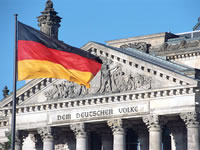
Learning English alone is not enough to keep up with the trends in Germany, which is at the forefront of EU integration and disseminates a wide variety of information. The fact that so many world-famous writers and musicians are from Germany or Austria also makes learning German more meaningful. Those who have acquired the ability to read German newspapers, magazines, novels, and sheet music in the original language will be able to find opportunities for success in public and private exchanges with German-speaking countries and in business in the cultural field.
Japanese conversation that even Germans can understand
|
"The basic technique for creating spurs on the white slopes is of course the Bogen."
|
|
"Rucksack, jacket and rope, the mountains are calling me."
|
|
"Xylitol prevents tooth decay, and glycogen keeps you full of energy."
|
What kind of language is German? Is it related to English?
German belongs to the so-called Germanic languages, or more specifically, the West Germanic group of languages. English and Dutch are also in this group. Here are some examples of how closely related these languages are to each other:
(1) What is that?
(2) What is it?
(3) What is it?
(1) What is that?
(2) What is it?
(3) What is it?
(1) is English, (2) is Dutch, and (3) is German. Of course, all three mean "What is it?" The difference between these expressions is about the same as the difference between "What are you talking about?" and "What is it?" Here's another example.
(1) I have a book.
(2) I can't stand it.
(3) I have a book.
(1) I have a book.
(2) I can't stand it.
(3) I have a book.
Here's how you say "I have one book" in the three languages above. It's not difficult if you think of it as "I" becoming "washi" and "motteimasu" becoming "motto mareru." Next, I'll give you some German words. Here are some words that indicate parts of the body.
Hand
Finger
Lippe (Lip)
Hand
Finger
Lippe (Lip)
These examples may give the impression that German and English are almost the same, but of course there are differences. Next, I will give an example that clearly shows the difference with English. First, how to read the alphabet.
|
A |
B |
C |
D |
E |
F |
G |
H |
I |
|
J |
K |
L |
M |
N |
O |
P |
Q |
R |
|
S |
T |
U |
V |
W |
X |
Y |
Z |
|
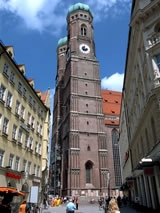
Other unique German characters include
Ä (ä) [A-umlaut]
Ö (ö) [Oumlaut]
Ü (ü) [U-umlaut]
ß [S-Zett]
You will learn how to actually use these characters in class.
Ä (ä) [A-umlaut]
Ö (ö) [Oumlaut]
Ü (ü) [U-umlaut]
ß [S-Zett]
You will learn how to actually use these characters in class.
everyday expression
|
Good morning!
|
(Guten Morgen)
|
"good morning"
|
|
Guten Tag!
|
(Guten Tag)
|
"Hello"
|
|
Good evening!
|
(Guten Abend)
|
"Good evening"
|
|
Thank you!
|
(Danke Schon)
|
"thank you"
|
|
Auf Wedersee!
|
(Auf Wiedersehn)
|
"Goodbye"
|
Morning, evening and evening greetings and expressions of thanks are somewhat similar to English. However, saying "goodbye" is completely different. English and German are independent languages, so it's only natural that there are differences. When studying German, it is important to remember the changes in verbs, auxiliary verbs, nouns, articles, adjectives, etc., such as "personal changes" and "case changes." This is the same for French, Spanish, Italian, etc.
Famous German speakers
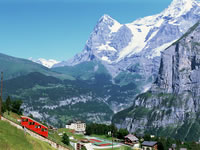
We have selected famous German, Swiss, and Austrian scholars, artists, and politicians who are native German speakers from high school world history textbooks. German is an important language for literature and academia, and 20% of the books published worldwide each year are written in German.
Einstein (physicist famous for the theory of relativity) / Adenauer (politician) / Wallenstein (military man) / Engels (thinker) / Gutenberg (inventor of the printing press) / Kafka (literary figure) / Karl Liebknecht (socialist activist) / Karl Barth (theologian) / Kant (philosopher) / Brothers Grimm (literary figure) / Lucas Cranach (painter) / Goethe (literary figure) / Kohl (politician) / Koch (bacteriologist famous for creating tuberculin) / Schoenberg (musician) / Schiller (literary figure) / Savigny (jurist) / Schubert (musician) / Spengler (philosopher) / Schumann (musician) / Strauss (musician) / Stresemann (politician) / Schliemann (archaeologist) / Schlegel brothers (literary figure) / Schopenhauer (philosopher) / Freud (psychologist) / Schroeder (politician) / Daimler (mechanical engineer, automobile manufacturer) / Zwingli (Swiss religious reformer) / Diesel (inventor of the diesel engine) / Dürer (painter) / Thomas Mann (literary figure) / Nietzsche (philosopher) / Novalis (literary figure) / Heisenberg (physicist) / Heidegger (philosopher) / Haydn (musician) / Heine (literary figure) / Paul Klee (painter) / Bach (musician) / Bismarck (politician) / Hitler (politician) / Fichte (philosopher) / Brandt (politician) / Brecht (literary figure) /W. Humboldt (linguist) /Beethoven (musician) /Hegel (philosopher) /Helmholtz (physicist) /Handel (musician) /Holbein (painter) /Max Weber (sociologist) /Meinecke (historian) /Mayer (physicist) /Maria Theresa (House of Habsburg) /Marie Antoinette (House of Habsburg and Queen of France) /Karl Marx (thinker) /Mendel (discoverer of the laws of heredity) /Mendelssohn (musician) /Mozart (musician) /Jaspers (philosopher) /Leibniz (philosopher and mathematician) /Ranke (historian) /Friedrich List (economist) /Liebig (chemist) /Martin Luther (German Reformation leader) /Lessing (man of letters and philosopher) /Roentgen (discoverer of x-rays) /Reuchlin (humanities scholar and classical scholar)
Short-term/long-term study abroad
Partner institutionsMartin Luther University Halle-Wittenberg (Saxony-Anhalt)、CDC (Carl Duisberg Center) BerlinThis course is held in spring and summer. The long-term study abroad destinations are the main campus in Halle,University of Passau(Bavaria).
Dictionaries and encyclopedias
Germany
A dictionary with about 60,000 words is sufficient for beginners to intermediate students, but for specialized learning, a dictionary with more than 100,000 words is required. We recommend the latest version that supports the new orthography.
- "Crown German-Japanese Dictionary" (Sanseido)
- "Progressive German-Japanese Dictionary" (Shogakukan)
- “New Apollo German-Japanese Dictionary” (Dogakusha)
- "New Access German-Japanese Dictionary" (Sanshusha)
- "New Meister German-Japanese Dictionary" (Taishukan Shoten)
- “Freude German-Japanese Dictionary” (Hakusuisha)
- "New Modern German-Japanese Dictionary" (Sanshusha)
- "German-Japanese Dictionary" (Shogakukan)
Japanese and German
- "Japanese-German Dictionary" (Ikubundo)
- "New Concise Japanese-German Dictionary" (Sanseido)
- "Modern Japanese-German Dictionary" (Sanshusha)
Electronic dictionary
- "EX-word (German-Japanese/Japanese-German)" (Casio)
- "SR-V5010" (Seiko)
- "PW-E510 (with German-German dictionary)" (Sharp)
A handbook for discovering German-speaking countries
- "Modern Germany Information Handbook + Austria and Switzerland" by Susumu Aima et al. (Sanshusha)
- "60 Chapters to Understand Germany" by Tozo Hayakawa et al. (Akashi Shoten)
Major examinations and qualifications
- German Proficiency Test Levels 1-5 (Dokuken*/Japan Association for the Promotion of German Language and Literature)
- Goethe German Exam A1-C2 (Goethe-Institut)
- German for Professionals (ZDfB) (Goethe-Institut)
*You can take the German Proficiency Test at Musashi University.
■ Department of European Studies offers a course to prepare for the German Proficiency Test (students from other departments can also take this course).
■ For Successful applicant Successful applicant German Examination and Goethe German Proficiency TestMusashi University Foreign Language Learning Award and EncouragementThere is. Please give it a try.
■ Department of European Studies offers a course to prepare for the German Proficiency Test (students from other departments can also take this course).
■ For Successful applicant Successful applicant German Examination and Goethe German Proficiency TestMusashi University Foreign Language Learning Award and EncouragementThere is. Please give it a try.