
 3S
3S


Musashi Campus Life
My Day
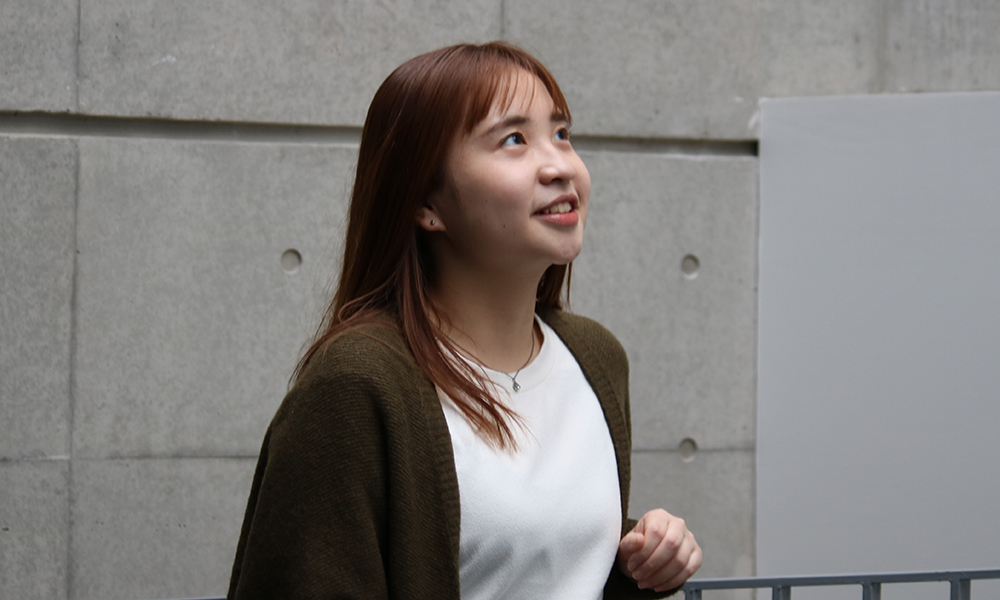
Department of Management Faculty of Economics Department of Business Administration
[Licenses to obtain] Junior High School teacher's license (social studies), High School teacher's license (geography, history, civics, information)
[Licenses to obtain] Junior High School teacher's license (social studies), High School teacher's license (geography, history, civics, information)
One Monday
- 6:00 Wake up
- 9:00 1st period: "Moral Education"
- Students will learn about the teaching methods and contents of moral education and moral studies in Junior High School. They will also have the opportunity to experience their first mock lesson, and will be reminded that moral studies is an important subject.
- 10:55 2nd period "Introduction to Japanese History"
- In this class, you can look at Japanese history from various angles, such as the history of religion, the history of the samurai, and the history of Japan from a foreign perspective.
- 12:40 Lunch break
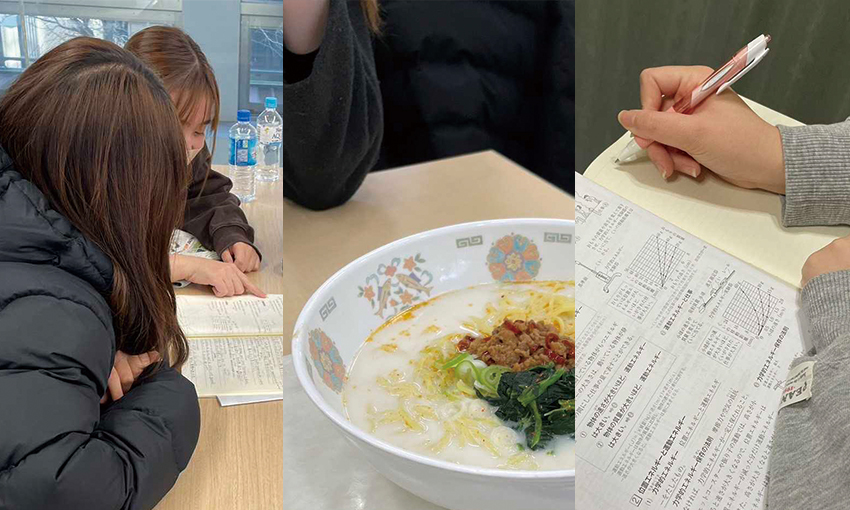
- I often eat with friends who are taking teaching classes. We talk about a variety of things, from classes to personal matters. Talking with friends is the best way to relax.
- 13:25 Vacant (3rd period)
- I review the morning lectures and take on-demand classes. One of the things I enjoy is studying in the Learning Commons on the third floor of Building 11, which will be built in 2022.
- 15:20 4th period "Specialized Seminar Part 1"
- As the name suggests, Musashi is a place of seminars, and seminar activities are very fulfilling. Through group work and other activities, students cooperate with each other to achieve the seminar's goals.
- 17:15 5th period "Educational Guidance"
- We learn that student guidance is an important part of a teacher's job, along with teaching instruction. The lectures include actual examples from teachers, so it is a fulfilling class that allows you to understand the situation that is occurring in the field.
- 20:00 After school (part-time job)
- I work part-time at a cram school two days a week, teaching mainly junior high school students and preparing and reviewing their lessons.
Musashi University 2nd year spring semester schedule
| Class | Mon | Tue | Wed | Thu | Fri |
| 1st period | Theory of moral education and Practice |
Educational Psychology 1 | |||
| 2nd period | An Overview of Japanese History | English II | Social studies/ Civics Educational Methods 1 |
||
| 3rd period | Sociology Introduction | Foreign History Overview | |||
| 4th period | Specialized Seminars | Principles of Education 2 | Social studies/ Geography and History Educational Methods 1 |
||
| 5th period | Educational Guidance | ||||
| 6th period | 〇Innovation theory Business History 1 〇Venture company theory 1 Marketing 1 Microeconomics |
〇Business Management 1 〇Business Strategy 1 |
Career Design Theory A 〇Human resource management theory 1 |
〇 is an intensive lecture
My Four Years
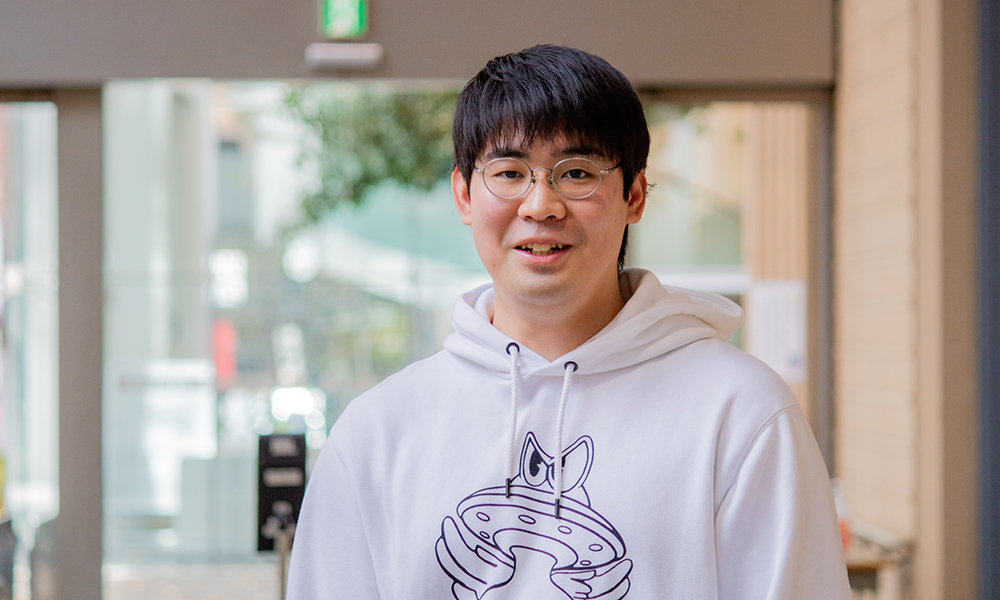
Faculty Faculty of Humanities Department of Japanese and East-Asian Studies
[Licenses to obtain] Junior High School teacher's license (Japanese language), High School teacher's license (Japanese language)
[Licenses to obtain] Junior High School teacher's license (Japanese language), High School teacher's license (Japanese language)
First Year: The Beginning
I wondered what and how I would learn in a university, a space unlike any other school I had ever been to. I think the past year has been a mixture of excitement and anxiety about learning with people I don't know at all, and in a completely different environment.
Everything I saw, heard, and took in was fresh and shining. In Teacher Training Course, I was able to objectively look at my own teaching experience through "Introductory Seminar on Teacher Training" and "Principles of Education 1," and I think I was able to draw a path toward the current and future of my school that goes beyond my own experience.
Everything I saw, heard, and took in was fresh and shining. In Teacher Training Course, I was able to objectively look at my own teaching experience through "Introductory Seminar on Teacher Training" and "Principles of Education 1," and I think I was able to draw a path toward the current and future of my school that goes beyond my own experience.
Second Year: Facing Connections
Classes have begun in earnest to obtain a teaching license, including how to teach subjects and student guidance.
Was this a year in which you became more conscious of what it means to stand in front of a classroom?
The word "remote," which has become commonplace now, seemed like a new concept that humanity had discovered at the time. It gave me the opportunity to think, while I was at university, about what technology should be like when people return to face-to-face interactions, and how education can contribute to people's happiness.
Was this a year in which you became more conscious of what it means to stand in front of a classroom?
The word "remote," which has become commonplace now, seemed like a new concept that humanity had discovered at the time. It gave me the opportunity to think, while I was at university, about what technology should be like when people return to face-to-face interactions, and how education can contribute to people's happiness.
Third year: Days thinking about "school"
It was a year to objectively re-examine the existence of the school more than ever.
In the learning so far, it has been done to objectively re-examine the existence of schools. An attitude to move away from the perception that "school is an infallible space" and to re-perceive schools broadly is required in the Teacher Training Course of Musashi University for four years. However, in the past two years, I have learned about basic matters such as the education system and course of study, as well as how to teach subjects.
In the third year, based on these learnings, various things such as institutionalized schools and de-school theories, existence and social demands that have not been accepted in previous schools, and teachers' attitudes in class were dealt with, and they thought through them. I also experienced that dialogue with guest speakers deepened my own thoughts.
As a person heading towards Teaching Practicum, I was able to create a core of what I would learn and behave after entering school.
In the learning so far, it has been done to objectively re-examine the existence of schools. An attitude to move away from the perception that "school is an infallible space" and to re-perceive schools broadly is required in the Teacher Training Course of Musashi University for four years. However, in the past two years, I have learned about basic matters such as the education system and course of study, as well as how to teach subjects.
In the third year, based on these learnings, various things such as institutionalized schools and de-school theories, existence and social demands that have not been accepted in previous schools, and teachers' attitudes in class were dealt with, and they thought through them. I also experienced that dialogue with guest speakers deepened my own thoughts.
As a person heading towards Teaching Practicum, I was able to create a core of what I would learn and behave after entering school.
Year 4: Learning to communicate, learning through connections
It was the most valuable and important day for me.
With Teaching Practicum, I was keenly aware of the difficulty and seriousness of teaching students every day, unlike mock classes.
Teaching Practicum dealt with the classics, but since the undergraduate department dealt with the literature of the previous generation, I ran through the three weeks while connecting the learning at the undergraduate school to find out where the fun and charm of the classics lies in high school students. Learning at the undergraduate level led to the interest of students in unexpected places, and I gained a lot of learning and realization that I could not understand just by watching the class.
I also took the teacher recruitment exam. In order to pass the teacher recruitment exam, along with the Examinee of the teacher recruitment exam on campus, we reviewed what we had learned so far about education, classes, and school management, and discussed studying literature with Faculty of Humanities teachers. Thanks to that, I was able to pass.
Through my four years of study Teacher Training Course, I was able to develop an attitude of putting my undergraduate studies and Teacher Training Course learning into practice, rather than focusing on one side. Even after graduation, I would like to face students honestly without neglecting my studies.
With Teaching Practicum, I was keenly aware of the difficulty and seriousness of teaching students every day, unlike mock classes.
Teaching Practicum dealt with the classics, but since the undergraduate department dealt with the literature of the previous generation, I ran through the three weeks while connecting the learning at the undergraduate school to find out where the fun and charm of the classics lies in high school students. Learning at the undergraduate level led to the interest of students in unexpected places, and I gained a lot of learning and realization that I could not understand just by watching the class.
I also took the teacher recruitment exam. In order to pass the teacher recruitment exam, along with the Examinee of the teacher recruitment exam on campus, we reviewed what we had learned so far about education, classes, and school management, and discussed studying literature with Faculty of Humanities teachers. Thanks to that, I was able to pass.
Through my four years of study Teacher Training Course, I was able to develop an attitude of putting my undergraduate studies and Teacher Training Course learning into practice, rather than focusing on one side. Even after graduation, I would like to face students honestly without neglecting my studies.
Contact UsInquiry
Musashi University Teacher Training Course
- Tel
- 03-5984-3729
- address
- Musashi University Building 8, 1F, 1-26-1 Toyotama-kami, Nerima-ku, Tokyo 176-8534
Opening hours: Weekdays 9:00-16:40