
 3S
3S


NEWS & EVENTS

2025.07.17
- Education and Research
- student life
- Academic Affairs Division
notice
[Cross-departmental seminar] Final report session for the spring semester of 2025 held
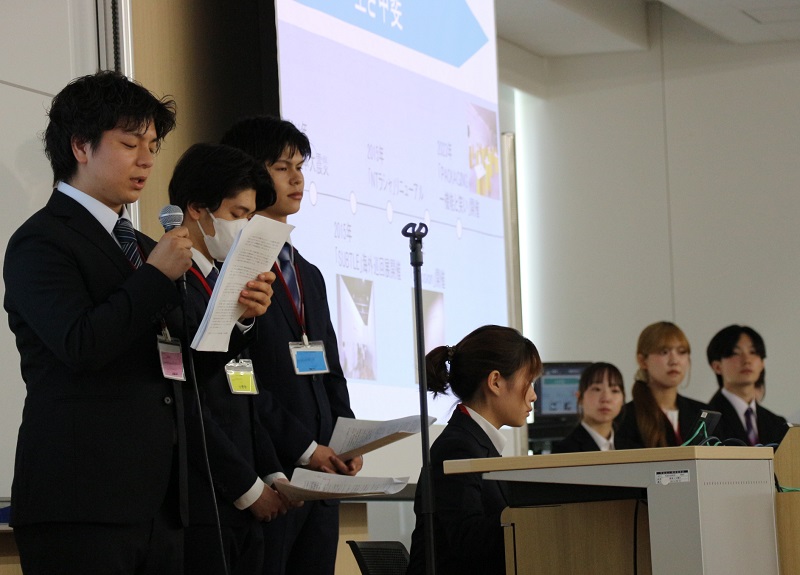
On Saturday, July 5th, the final report session for this year's spring semester "Interdisciplinary Seminar Project (Course Name: Interdisciplinary Problem-Solving Project)" was held, open to the public, with representatives from Takeo Co., Ltd., the company that provided the project, invited to our university.
There are two assignments for this class:
1) Create a booklet that organizes the social roles and contributions of partner companies from the perspective of social issues.
② Think about how to create our future through companies that provide solutions to these social issues.
There are two assignments for this class:
1) Create a booklet that organizes the social roles and contributions of partner companies from the perspective of social issues.
② Think about how to create our future through companies that provide solutions to these social issues.
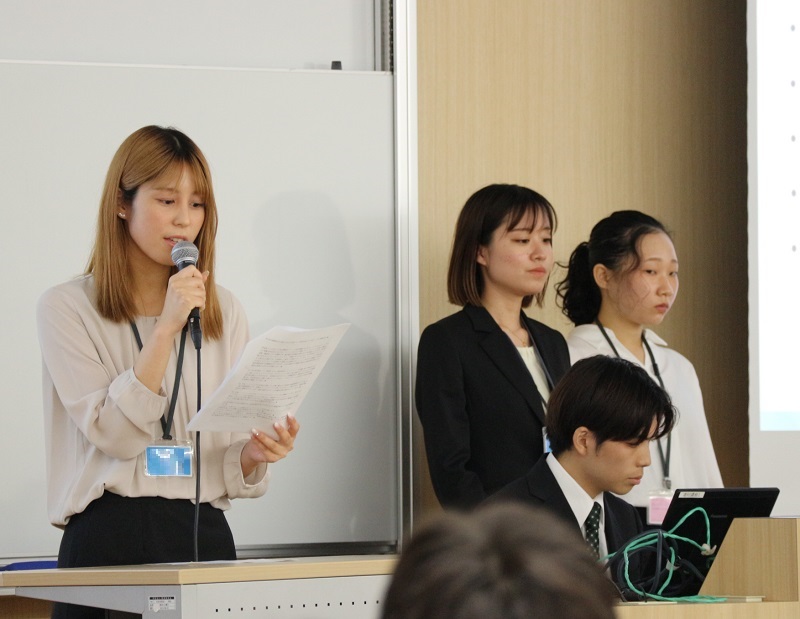
In the spring semester, the course is open to second-year students and above. This semester, 17 students, consisting of 10 second-year students and 7 third-year students, took the course. They split into two teams and conducted research and analysis on Takeo Co., Ltd., a specialized paper trading company, as well as the history and culture of paper and the social issues surrounding paper.
The students divided into faculties and continued their analysis, making use of their respective faculty's expertise, until the mid-term presentation on May 24. After the mid-term presentation, they worked in cross-faculty teams to consider "proposals for addressing social issues surrounding partner companies," making use of the research and analysis they had conducted up to that point.
A total of 76 people participated in the final presentation, including online participants, and both teams gave 30-minute presentations. A simple printed version of the booklet was distributed to attendees at the venue, and a PDF version was shared on the screen at the online venue for participants to read.
After the presentations, company representatives and university officials commented, "I was surprised and impressed that they were able to consider the issue up to three months in advance," "It was good that the presentations made use of the expertise and individuality of each faculty," and "The perspective was centered on the present day, but our relationship with paper goes back a long way historically, and the accumulation of that time has led to the appeal of paper. It would have been even better if the proposal had also incorporated this historical perspective."
The students divided into faculties and continued their analysis, making use of their respective faculty's expertise, until the mid-term presentation on May 24. After the mid-term presentation, they worked in cross-faculty teams to consider "proposals for addressing social issues surrounding partner companies," making use of the research and analysis they had conducted up to that point.
A total of 76 people participated in the final presentation, including online participants, and both teams gave 30-minute presentations. A simple printed version of the booklet was distributed to attendees at the venue, and a PDF version was shared on the screen at the online venue for participants to read.
After the presentations, company representatives and university officials commented, "I was surprised and impressed that they were able to consider the issue up to three months in advance," "It was good that the presentations made use of the expertise and individuality of each faculty," and "The perspective was centered on the present day, but our relationship with paper goes back a long way historically, and the accumulation of that time has led to the appeal of paper. It would have been even better if the proposal had also incorporated this historical perspective."
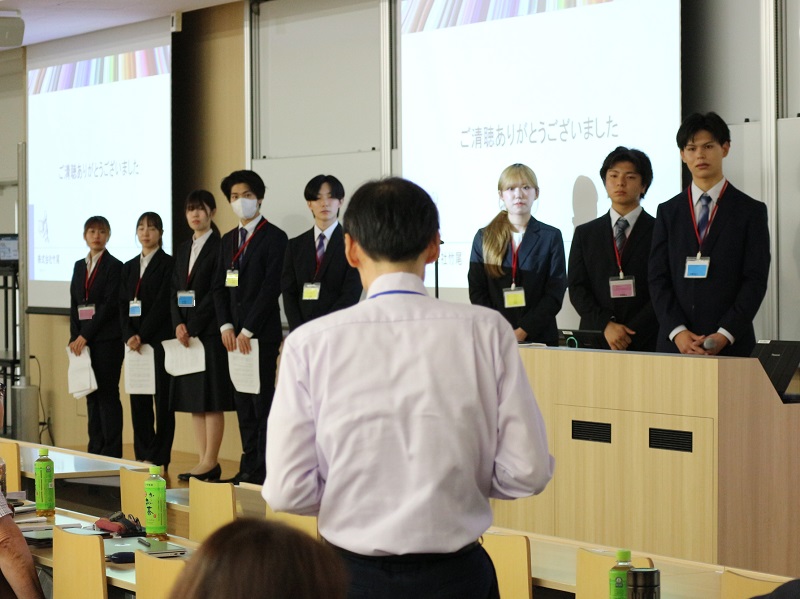
The concepts the students came up with for their presentations at the final presentation session were "A love of knowledge and beauty" and "Coloring life, coloring the future." The students, known as digital natives, came across the concepts of "cultural capital" and "visual communication" while seriously researching and analyzing paper. They concluded that "paper enriches people's lives," and came up with this proposal with the hope of spreading awareness of its benefits.
One of the features of this class is its collaboration with industry and academia, but the fact that students can think about solving social issues in a real-life context further deepens their learning.
In the coming fiscal year, we would like to continue developing this project, while valuing a diverse perspective and an attitude of continuing to question the issue of examining social issues through corporate initiatives, which has no correct answer.
One of the features of this class is its collaboration with industry and academia, but the fact that students can think about solving social issues in a real-life context further deepens their learning.
In the coming fiscal year, we would like to continue developing this project, while valuing a diverse perspective and an attitude of continuing to question the issue of examining social issues through corporate initiatives, which has no correct answer.
Students' impressions after the final presentation (from class SNS)
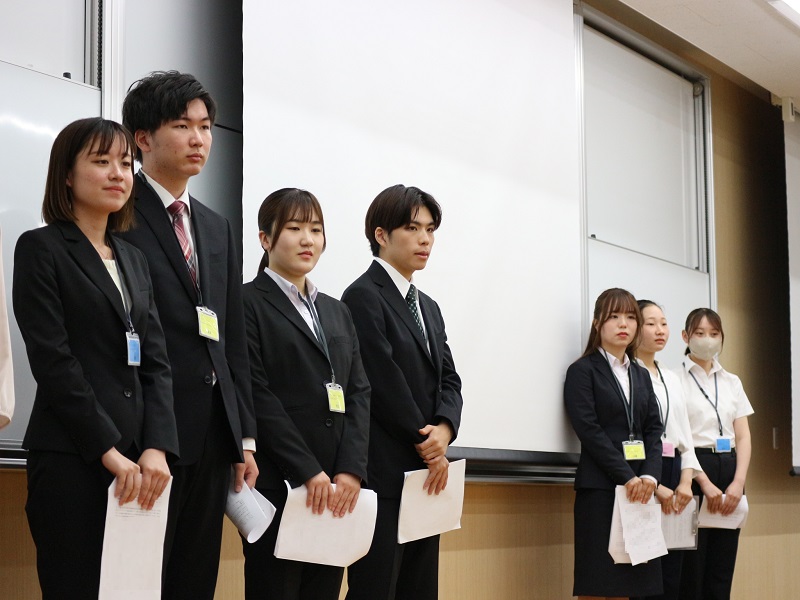
"Until today, it has been a lot of fun to see my team members face-to-face every day from morning until night, working towards the same goal. I have always enjoyed working in teams with multiple people, but this seminar activity made me realize how difficult team activities can be. When people with different ways of thinking and opinions come together, sometimes the discussions don't go well. However, by having everyone on an equal footing, exchanging opinions freely, and discussing towards the same goal, I think we were able to create something better. There were difficult moments, but I felt a great sense of accomplishment.
In Phase 2, by bringing together people from various faculties, it was very interesting to see how each faculty had different ways of thinking and areas of expertise. By approaching one thing from different angles, new things were born and ideas became stronger. I was able to participate in the discussions without hesitation, think about how to convey my opinions, and then express them. I was also able to incorporate opinions flexibly and summarize them. I personally believe that my "communication skills" and "flexibility" have improved. The cross-disciplinary seminar allowed me to experience the significance of team activities.
In Phase 2, by bringing together people from various faculties, it was very interesting to see how each faculty had different ways of thinking and areas of expertise. By approaching one thing from different angles, new things were born and ideas became stronger. I was able to participate in the discussions without hesitation, think about how to convey my opinions, and then express them. I was also able to incorporate opinions flexibly and summarize them. I personally believe that my "communication skills" and "flexibility" have improved. The cross-disciplinary seminar allowed me to experience the significance of team activities.
Click here for the Interdisciplinary Problem-Solving Project homepage
Click here for the cross-departmental seminar blog
Click here for the cross-departmental seminar blog