
 3S
3S


NEWS & EVENTS

2026.06.30
- Education and Research
- Faculty of Humanities
- Public Liaison Department
notice
Department of European Studies Kenichiro Komori Professor Author's Book, 'The Intellectual History of the Anti-Semitic' — On the Origins of the Enduring Nakba'
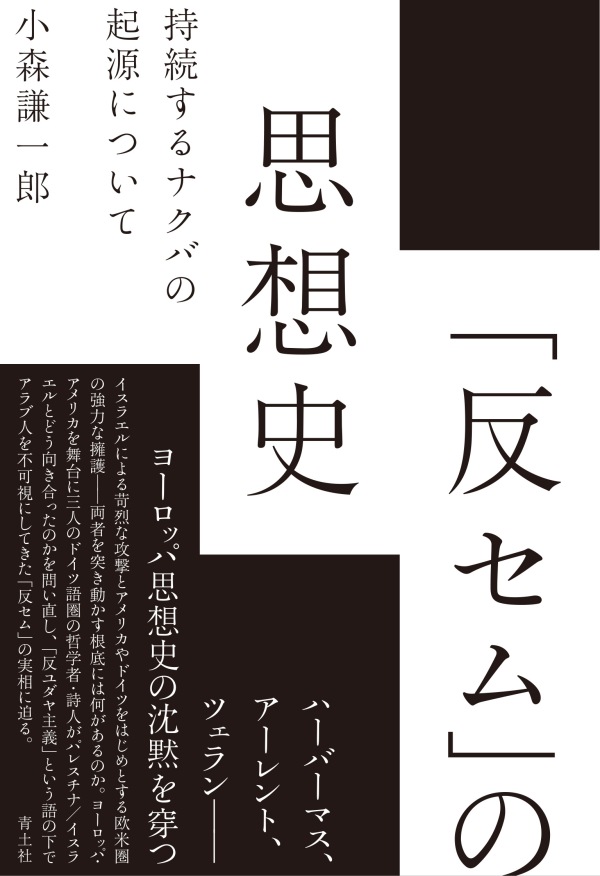
Professor Department of European Studies Kenichiro Komori 's solo book, 'A History of Anti-Semitic Thought—On the Origins of the Enduring Nakba,' has been published.
- "The Intellectual History of the Anti-Semites: On the Origins of the Persistent Nakba" (Seidosha)
- Kenichiro Komori (Professor Department of European Studies)
Overview
You may know the story of Noah, who saved his family and animals from the flood in the Ark. Genesis chapter 9 states that all humanity came from Noah's three sons. His three sons are Japheth, Shem, and Ham. Traditionally, the descendants of Yapheth are Europeans, the descendants of Shem are Asians, and the descendants of Ham are Africans.
By the way, in Genesis chapter 9, because of Ham's disrespect, his son Canaan is cursed. Noah says that the descendants of Canaan (that is, the descendants of Ham) should become slaves to the descendants of Japheth and Shem. Around the 15th century, African blacks were truly enslaved by Europeans, and the slave trade began. This led to the significant development of commercial capitalism. The people of Europe must have felt as if Noah's words had come true.
However, in the 19th century, the slave trade and slavery were gradually abolished, and around the same time, commercial capitalism also transitioned to industrial capitalism. It was also a period when Britain and France were expanding their colonies. With the advancement of capitalism, the African black people, descendants of Ham, have become insufficient in terms of labor, but Europe has found people to fill that gap. Of course, they are people from Asia who have been considered descendants of the Semites.
That said, in Genesis chapter 9, only Ham and his descendants are cursed, while Shem and his descendants are blessed in the opposite way. This is where racial ideology that does not rely on biblical accounts comes into play. It holds the view that Asians are inferior to Europeans, and French linguist Ernest Renan actually made such discourse in the mid-19th century. Europeans are a race of soldiers and a ruling race. Black and Asian people lack military character and are considered a dominant race.
This book positions Renan's discourse as the origin of the "anti-Semitic" movement. For Lunan, the "true Semites" were the "Turks" (inhabitants of the Ottoman Empire). They are people who connect to Arabic as a Semitic language through the Quran. "Islam is the most complete denial of Europe," Renan writes. These discourses justified France's colonization of northwest Africa.
On the other hand, Semitic languages also include Hebrew. Traditionally, Jews have also been considered descendants of Semites (that is, Asians). Renin considered contemporary Jews to be Europeanized, but the tendency to discriminate against them as 'Oriental' originated in unified Germany after the Franco-Prussian War. That is the "anti-Semitism" that remains to this day. In Japanese, it is mostly translated as 'anti-Semitism.'
In Japanese, 'anti-Semitism' is an easy-to-understand translation that emphasizes that the target of discrimination is Jews. However, this translation is precisely missing the word 'Sem,' and all the historical, religious, and political backgrounds mentioned above are lost. Considering that the term "anti-Semitism" remains mainstream in Western countries, many things are lost due to this absence.
However, even in Western countries, the term "anti-Semitism" is still used, but its target audience is almost exclusively Jews. The reality is that very few people return to the view that Arabs were originally included. Why is that?
This was because Nazi Germany's "anti-Semitism," which caused the Holocaust, targeted exclusively Jews. And in the mid-1980s, through the film 'SHOAH' and the historian debate, a view emerged that regarded the Holocaust as a 'unique' event. Furthermore, this way of thinking became established in Western countries, including Japan, through the 'politics of memory' since the 1990s (during which events such as German reunification, the collapse of the Cold War, and European integration followed).
In this process, Renand's rhetoric and his contempt for the "Turks" were completely forgotten. Since the 1980s, there has been some improvement in discrimination against Jews in Western countries. However, the view of Muslims as "Europe's most complete denial" and hostile views has remained largely untouched and continues to this day (the events of September 11, 2001, ironically reinforced this view).
Looking at it this way, it may be natural that Jürgen Habermas, the winner of the historians' debate, continued to defend Israel in the face of the devastation in Gaza after October 2023.
This book examines the "origins of the enduring Nakba" from the above perspectives and attempts to explore the scope of "anti-Semitic" movements in Europe through Habermas, Arendt, and Tseran
A word from the author
The first chapter of this book examines what was probably not visible to Habermas's eyes. Where exactly was the main issue in the historian debate? Scholars have questioned whether they could have referred to Eric Williams' 'Capitalism and Slavery' or Aimé Cézère's 'On Colonialism,' and whether there was no shortfall in Habermouth's theory of the public sphere, which does not touch on slavery or colonies.
As a premise for considering these questions, the book historically examines how "anti-Semitism" unfolded from the Dreyfus Affair through Wilhelm II's "world policy" to Auschwitz's "Muselmann."
The book's view is that "anti-Semitism" was a two-layered racial framework based on latent inferiority perceptions toward Turks and Arabs, and that Jews who "tried to rise" were ultimately considered "Semites" like them.
However, the underlying underlying inferiority of Arabs has gradually been forgotten, and instead, the view that limits "anti-Semitism" to Jews who are victims of the Holocaust has been firmly established through the film "SHOAH" and the historians' debates. From this emerges the label commonly seen today: criticism of the State of Israel is also labeled as "anti-Semitism."
It can be said that the serious fight against such labels was sparked in 2012 by Judith Butler's "The Crossroads" and Günter Grass's "What Must Be Said." The film 'Hannah Arendt' (directed by Margarete von Trotta), released that same year, is also at the center of this trend.
In the previous year, 2011, Israel passed the so-called Nakba Law, which restricted Palestinians from even commemorating their own "calamities." Another book I translated, 'The Holocaust and the Nakba,' was also born from this series of trends.
The label "anti-Semitism" was internationally justified by the IHRA in 2016, and scholars opposing it issued the "Jerusalem Declaration" in 2020 (for details, see my essay "Persistent Nakba, Recurring Holocaust—A Reflection on the Current Situation").
In Chapter 2 of this book, after introducing these trends, it focuses on how Hannah Arendt faced Israel after 1967.
The famous 'Biography of Arendt' by Elizabeth Young=Bruell was published in 1982. "There, Arendt is considered to have been a fervent Zionist," Edward Said pointed out in 1985. Because his biography stated that in 1967 and 1973, during the Third and Fourth Middle East Wars, Arendt donated to the extremist "Jewish Defense League JDL."
JDL's founder, Meir Kahane, was a strong advocate for the military exclusion of Palestinians and Arabs, and it is said that current Israeli government ministers are also greatly influenced by this. If a prominent scholar like Arendt had donated to this organization, it would mean, so to speak, that the recent behavior of the Israeli government had already been endorsed in advance.
Young=Bruell, who was pointed out by Saeed, admitted the mistake that Arendt had donated to another organization. However, the revised second edition of 'Arendt' was published in 2004. In other words, for over 20 years, Arendt had supported Kahaneism, which did not hesitate to commit terrorism.
As a result, opinions spread that Arendt was a bigot, or that he was fundamentally Zionist and colonial. On the other hand, it is true that Arendt as an assimilated Jew held stereotypical prejudices, that is, racist frameworks of perception. It is equally true that the war of 1967 was praised.
However, in the 1940s, he opposed the establishment of a purely Jewish state and advocated for a federal system between Jews and Arabs; regarding the Eichmann trial in the early 1960s, he claimed the Holocaust was a political "spectacle"; in 1969, he called writer Natalie Sarot, who insisted on "Israel's survival," a "Jew without reflection." And it is also true that he maintained a critical attitude toward Zionism throughout this time.
Based on the above, at the end of Chapter Two, we examine what Arendt should have written and could have written.
Chapter Three focuses on the poet Paul Tseran who viewed the 1967 war positively. Celan is a Jewish poet whose parents were killed in a Ukrainian concentration camp, and he himself was conscripted into forced labor. The "Fugue of the Dead" is especially famous.
In his poem "Think of It," Celan defended Israel's preemptive strike in June 1967. In the fall of 1969, he personally visited Israel and said, "I saw the once-in-a-lifetime great poetry open to the world." "What I engaged in dialogue was a calm—convicted determination to assert oneself within human matters," he told his fellow countrymen. However, six months later, the poet would throw himself into the Seine.
It is important that during this time, Celan met the philosopher Martin Heidegger (they met at least three times). In later years, Philippe Laque=Labarthes and Maurice Blanchot linked Heidegger's past of collaborating with the Nazis, his silence on 'extinction' and refusal to utter words of 'apology' to poets, to Celan's despair and suicide. This was in the mid-1980s, when the film 'SHOAH' was released and there was controversy among historians.
However, Celan knew Heidegger more deeply than Laku=Labart or Blanchot had imagined. And for poets of that time, the existence of Israel was probably more important than Heidegger's thoughts. This can be seen in the correspondence between his wife Giselle Le Range, his ex-lover Ingeborg Bachmann, and Ilana Shumueri, a Jewish woman living in Israel (all published in the 2000s).
Looking at it this way, Tseran may have thought that defending Israel with Heidegger-like language was an "irreparable mistake." Heidegger supported the Nazis in his speech titled "Self-Assertion of the German University," but Celan also stated that he saw "a determination to assert itself within the human world" in Israel. However, from the perspective of "elevating the world to something authentic" (Kafka), perhaps the poet came to think somewhere that his words were "unforgivable."
On the other hand, Tseran wrote in Shumueli, "It's even possible to live to a hundred." If I had lived to 2020 as those words said, I might have been able to rewrite the "Fugue of Death" with all that awareness had happened. In addition to the 'Blonde Margarete,' which suggests Germans, and 'Gray-haired Zuramit,' which suggests Jews, they could have sung 'Scheherazade the Gray-Haired Wolf,' which suggests Arabs.
In any case, what is most important today is to preserve the memory of the "plague" between Jews and Palestinians together. It will also be examined in light of the history of slavery and colonialism, opening up perspectives for the future. In that process, it will be essential to reconsider the present state of the nation-state and capitalism.
I hope this book will serve as a small inspiration for that.